
Mavic 3M Guide: Tracking Vineyards in Remote Areas
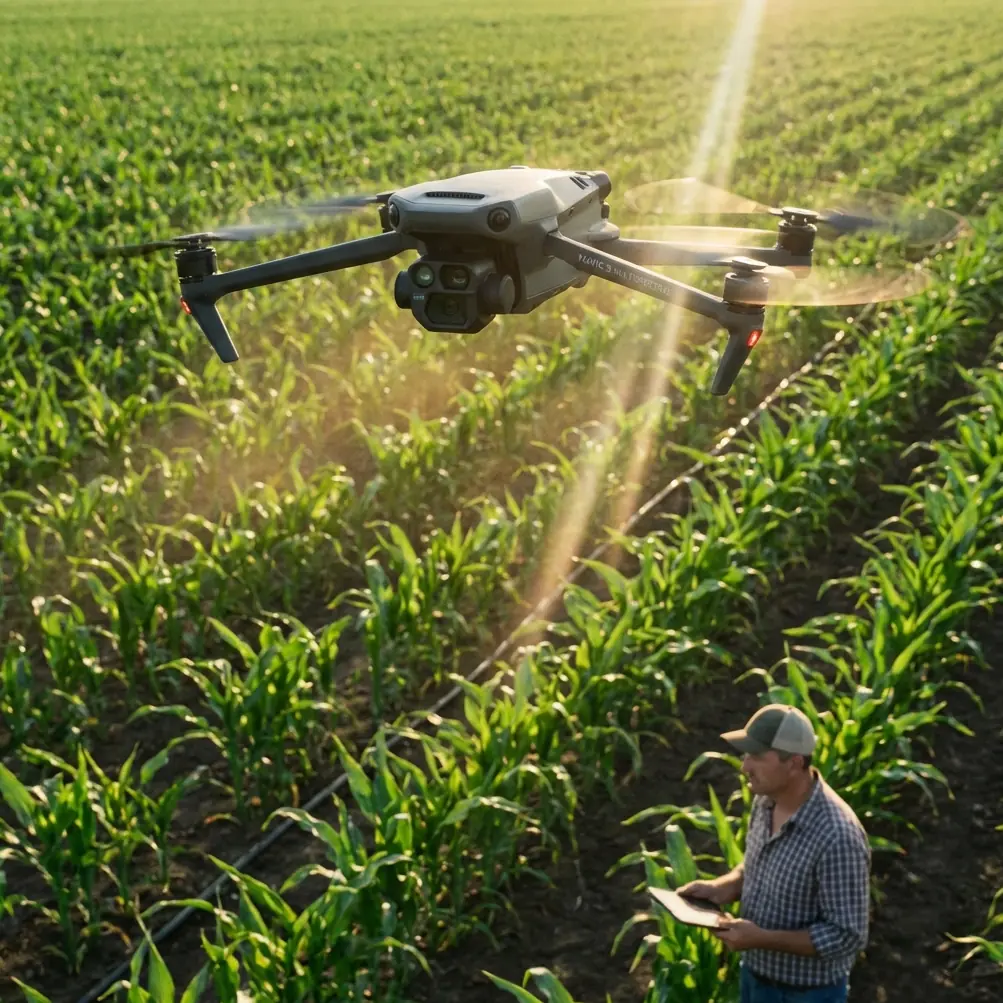
Mavic 3M Guide: Tracking Vineyards in Remote Areas
META: Learn how to use the DJI Mavic 3M for precision vineyard tracking in remote locations. Expert how-to guide covering multispectral imaging, RTK setup, and more.
Author: Marcus Rodriguez, Agricultural Drone Consultant
TL;DR
- The DJI Mavic 3M combines multispectral imaging with a mechanical shutter RGB camera to deliver actionable vineyard health data even in the most isolated growing regions.
- Achieving a reliable RTK fix rate above 95% is critical for centimeter-precision vine-row mapping—and this guide shows you how.
- Electromagnetic interference (EMI) in remote terrain can cripple your survey; proper antenna adjustment and frequency planning solve the problem before it starts.
- A structured flight workflow—from nozzle calibration checks to swath width optimization—ensures every hectare of canopy is captured accurately.
Why Vineyard Tracking in Remote Areas Demands the Mavic 3M
Remote vineyards present a unique set of challenges that generic consumer drones simply cannot handle. Sparse cellular coverage, rugged topography, variable canopy density, and unpredictable electromagnetic interference all conspire against consistent, repeatable data collection. The DJI Mavic 3M was purpose-built for exactly this environment.
Equipped with four multispectral sensors (green, red, red edge, and near-infrared) plus a 20 MP RGB camera, the Mavic 3M captures synchronized imagery across five bands simultaneously. That means you can generate NDVI, NDRE, and custom vegetation indices in a single flight—without swapping payloads or running duplicate missions.
This guide walks you through the end-to-end process of deploying the Mavic 3M for vineyard tracking, from pre-flight planning through data processing, with special attention to the real-world obstacles you will encounter in off-grid locations.
Step 1: Pre-Flight Planning for Remote Vineyard Sites
Assessing Connectivity and RTK Infrastructure
Before you load the Mavic 3M into the truck, answer one question: how will you achieve centimeter precision without reliable internet?
The Mavic 3M supports DJI's D-RTK 2 Mobile Station, which provides centimeter-precision positioning without a network RTK (NTRIP) connection. In remote vineyards, this is non-negotiable. A standalone base station eliminates dependence on cellular data and ensures your RTK fix rate stays above 95% throughout the flight.
Key planning steps:
- Scout the base station location. Choose a point with clear sky view (no overhead canopy) and stable, level ground.
- Verify satellite constellation availability. Use a GNSS planning tool to confirm that GPS, GLONASS, Galileo, and BeiDou coverage overlaps during your planned flight window.
- Download offline maps in DJI Pilot 2 before leaving cell coverage.
- Charge all batteries to 100%—there are no outlets between vine rows.
Defining Swath Width and Overlap
Swath width directly determines flight efficiency. The Mavic 3M's multispectral camera has a 73.9° field of view on each sensor. At a flight altitude of 30 m AGL, that translates to a ground swath of roughly 44 m.
For vine-row-level analysis, plan for:
- 75% frontal overlap and 70% side overlap as a minimum.
- GSD (ground sampling distance) of 1.27 cm/pixel at 30 m altitude on the multispectral sensors.
- Reduced altitude (15–20 m) if you need sub-centimeter GSD for individual vine health assessment.
Pro Tip: In hilly vineyard terrain, always enable Terrain Follow mode. The Mavic 3M uses its onboard DEM to maintain consistent AGL altitude, which keeps your GSD uniform across slopes that can exceed 25% grade.
Step 2: Handling Electromagnetic Interference with Antenna Adjustment
This is where most remote vineyard surveys go wrong—and where my own early missions taught me costly lessons.
The EMI Problem in Rural Environments
You might assume remote locations are EMI-free. They are not. Irrigation pump controllers, electric fencing systems, solar inverter arrays, and even high-voltage transmission lines crossing vineyard parcels all generate electromagnetic noise. I once lost telemetry lock three times in eight minutes over a vineyard in Mendoza because a solar pump inverter 800 meters away was operating on a frequency that interfered with the Mavic 3M's 2.4 GHz control link.
The Antenna Adjustment Solution
The Mavic 3M's DJI RC Pro Enterprise controller features dual-band communication at 2.4 GHz and 5.8 GHz with O3 Enterprise transmission. Here is how to optimize your antenna setup:
- Identify interference sources. Walk the vineyard perimeter with a handheld spectrum analyzer (even a basic SDR dongle and laptop work). Log any spikes in the 2.4 GHz and 5.8 GHz ISM bands.
- Switch frequency bands. If the 2.4 GHz band is congested, manually lock the controller to 5.8 GHz in the transmission settings. The shorter wavelength offers less range but dramatically better signal clarity in EMI-heavy environments.
- Angle the controller antennas. The flat faces of the RC Pro Enterprise antennas should always point toward the drone. In practice, this means tilting them forward as the Mavic 3M flies away and adjusting as it returns. A misaligned antenna can reduce effective signal strength by up to 50%.
- Position yourself on high ground. Even a 2–3 meter elevation advantage (stand on the truck bed) improves line-of-sight and reduces multipath reflection from vine canopy.
Expert Insight: If you consistently experience RTK float (not fix) during a mission, the problem is almost always EMI corrupting the correction data stream between the D-RTK 2 base station and the drone. Move the base station at least 20 m away from any metal structures, fencing, or electrical equipment. I now carry a 3 m tripod specifically for elevating the base station antenna above ground-level interference sources.
Step 3: Executing the Multispectral Survey Flight
Flight Parameter Configuration
Open DJI Pilot 2 and configure a Waypoint or Mapping mission with these recommended settings for vineyard tracking:
| Parameter | Recommended Setting | Notes |
|---|---|---|
| Flight altitude | 25–35 m AGL | Adjust based on required GSD |
| Flight speed | 5–7 m/s | Slower in high-slope terrain |
| Frontal overlap | 75–80% | Higher for 3D reconstruction |
| Side overlap | 70–75% | Ensures full vine-row coverage |
| Gimbal angle | -90° (nadir) | Standard for index mapping |
| White balance | Sunny (fixed) | Never use auto for multispectral |
| RTK mode | D-RTK 2 base station | Standalone, no NTRIP required |
| Image format | TIFF (multispectral) + JPEG (RGB) | TIFF preserves radiometric data |
| Sunlight sensor | Enabled | Compensates for irradiance changes |
Managing the Flight in Real Time
During execution, monitor three critical metrics on the controller display:
- RTK fix status. If the indicator drops from "FIX" to "FLOAT" or "SINGLE," pause the mission immediately. Resume only after fix is re-established.
- Battery level. The Mavic 3M delivers approximately 43 minutes of hover time, but mapping missions at 7 m/s with payload typically yield 30–35 minutes of usable flight. Land at 25% remaining.
- Image capture count vs. planned count. A mismatch indicates missed triggers—usually caused by flying too fast for the mechanical shutter cycle time.
Step 4: Post-Flight Data Processing for Vineyard Health Indices
Radiometric Calibration
Before each flight, photograph a calibrated reflectance panel with all five cameras. This ground-truth reference allows your processing software (DJI Terra, Pix4Dfields, or Agisoft Metashape) to convert raw DN values into absolute reflectance—critical for comparing data across flights taken on different days or under different lighting conditions.
Generating Actionable Indices
For vineyard management, focus on these indices:
- NDVI (Normalized Difference Vegetation Index): Identifies vigor variation across blocks. Values below 0.3 in mid-season typically indicate water stress or disease.
- NDRE (Normalized Difference Red Edge): More sensitive to chlorophyll content in dense canopy. Preferred over NDVI when LAI exceeds 3.0.
- Custom indices for spray drift analysis: Overlay pre- and post-application NDVI maps to assess whether your spray coverage matched the prescription. Gaps reveal spray drift issues tied to nozzle calibration errors or wind exposure.
Technical Comparison: Mavic 3M vs. Alternative Platforms
| Feature | DJI Mavic 3M | Competitor A (Fixed-Wing MS) | Competitor B (Multirotor MS) |
|---|---|---|---|
| Spectral bands | 5 (RGB + 4 MS) | 5 (MS only, no RGB) | 6 (RGB + 5 MS) |
| GSD at 30 m | 1.27 cm/px (MS) | 3.5 cm/px | 2.1 cm/px |
| RTK support | Yes (D-RTK 2) | Yes (built-in) | Optional add-on |
| Flight time | 43 min (hover) | 60 min | 28 min |
| Portability | Foldable, 951 g | Requires launch rail | Backpack, 3.2 kg |
| Weather resistance | IPX6K rated | IP43 | IP44 |
| Sunlight sensor | Integrated | External module | Not available |
| Terrain follow | Yes (DEM-based) | Limited | Yes |
The Mavic 3M's IPX6K rating deserves special attention. Remote vineyards mean unpredictable weather. An IPX6K-rated airframe withstands high-pressure water jets, so a sudden rain shower will not end your survey day or damage the multispectral optics.
Common Mistakes to Avoid
Skipping the reflectance panel. Without radiometric calibration, your NDVI values are relative, not absolute. You cannot compare data across dates, making seasonal trend analysis meaningless.
Flying in auto white balance mode. Auto adjustments shift color response between frames, corrupting spectral consistency. Always lock white balance to Sunny.
Ignoring the sunlight sensor. The Mavic 3M's top-mounted irradiance sensor compensates for changing cloud cover. If it is blocked by a sticker, dust, or an aftermarket accessory, your reflectance values will drift mid-flight.
Setting overlap too low to save battery. Dropping below 70% side overlap creates gaps between vine rows. You will not discover the gaps until processing—by which time you have already driven two hours home.
Neglecting nozzle calibration correlation. If you are using multispectral data to guide variable-rate spraying, verify that your sprayer's nozzle calibration matches the prescription map zones. A 10% nozzle flow error can negate the precision your Mavic 3M data provides.
Forgetting to check swath width against row spacing. If your vineyard rows are spaced at 2.5 m and your effective swath at altitude yields a GSD that cannot resolve individual rows, your vigor maps will blur inter-row soil with canopy—inflating NDVI artificially.
Frequently Asked Questions
Can the Mavic 3M operate without any cellular or internet connection?
Yes. The Mavic 3M operates fully offline when paired with the D-RTK 2 Mobile Station. Pre-load your maps and mission plans in DJI Pilot 2 before leaving connectivity. The RTK corrections are transmitted directly from the base station to the drone via a dedicated radio link—no internet required. This makes it ideal for remote vineyard sites where cellular coverage is nonexistent.
How does spray drift analysis work with multispectral data from the Mavic 3M?
You fly a multispectral survey before a spray application and another 48–72 hours after application. By comparing NDVI or NDRE maps, you can identify zones where canopy response changed (indicating successful product uptake) and zones where it did not (indicating the spray missed). Misses that follow a directional pattern—especially along field edges—are strong indicators of spray drift caused by wind or improper nozzle calibration. This data allows you to adjust nozzle type, pressure, and boom height for the next application cycle.
What RTK fix rate should I expect in mountainous vineyard terrain?
In terrain with significant elevation variation and limited sky view, expect an RTK fix rate between 90% and 97%, depending on satellite constellation density at your flight time. Valleys and steep north-facing slopes (in the Southern Hemisphere) can temporarily block satellites, causing brief drops to float. Using the D-RTK 2 base station on the highest accessible point in the vineyard and scheduling flights during peak satellite windows (check a GNSS planning tool) will keep your fix rate above the 95% threshold needed for centimeter-precision mapping.
Ready for your own Mavic 3M? Contact our team for expert consultation.