
Mavic 3M in Complex Terrain: What Bee-Inspired Return Logic
Mavic 3M in Complex Terrain: What Bee-Inspired Return Logic and LiDAR Workflows Reveal About Real-World Tracking
META: A technical review of Mavic 3M operations in complex terrain, connecting bee-inspired visual return methods, LiDAR mapping principles, and multispectral field reliability for tracking venues.
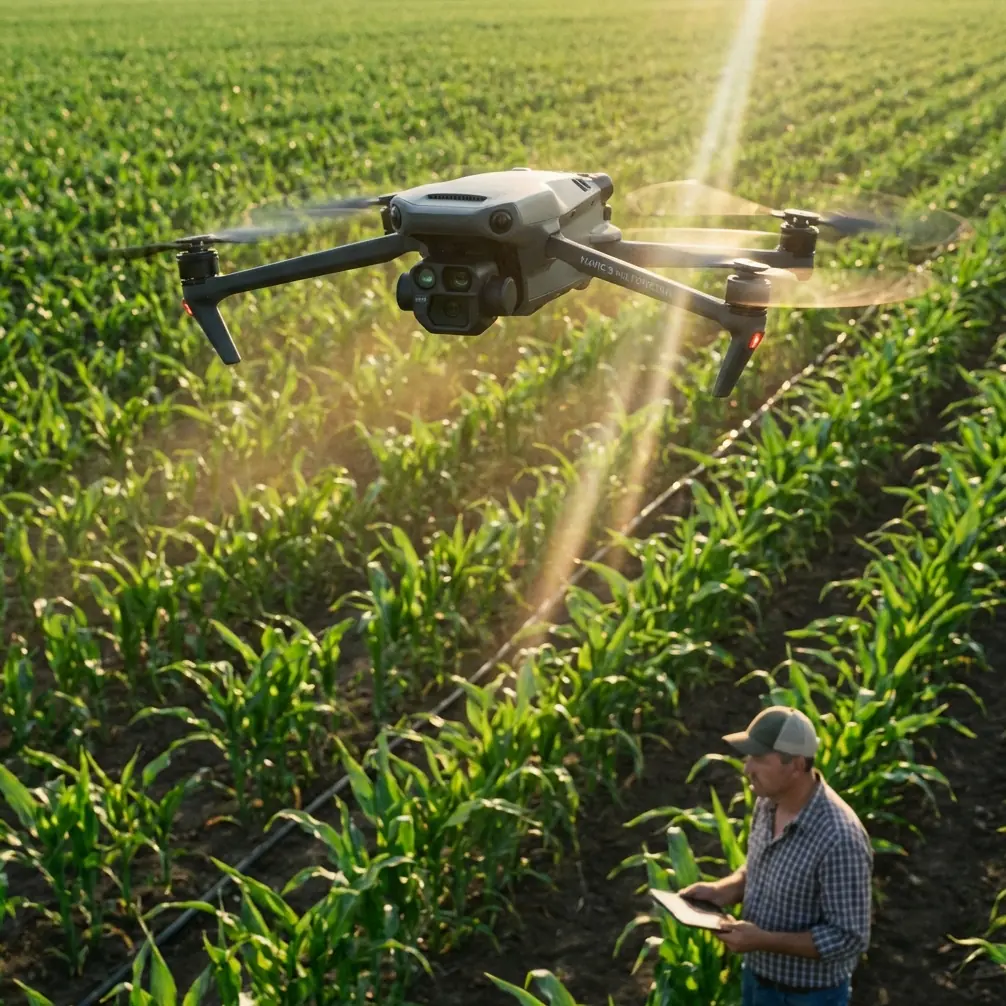
The Mavic 3M is usually discussed as an agriculture platform, and that is fair. Its multispectral payload, compact airframe, and field-ready workflow make it a practical tool for crop intelligence, stand counts, vigor assessment, and prescription support. But that framing can be too narrow when the actual mission is harder: tracking venues across broken terrain, uneven vegetation, narrow access routes, and visually repetitive landscapes where orientation errors become expensive.
That is where the most interesting recent research matters.
A study described a drone return method inspired by bee navigation. The striking detail is not just the biological metaphor. It is the scale: the navigation model reportedly used a neural network of only about 3.4 kilobytes. With that tiny footprint, the aircraft could interpret surrounding panoramic imagery, estimate its direction of travel, and infer its distance from home. For anyone operating a Mavic 3M around orchards, shelterbelts, terraced fields, wetlands, or fragmented trial sites, that concept deserves attention because it points to a more resilient way of thinking about return and relocation in GPS-challenging or visually confusing environments.
The practical question is not whether the Mavic 3M already ships with that exact method. It does not. The practical question is what this research tells us about how professional operators should design Mavic 3M missions when the venue itself is difficult to read.
Why complex terrain breaks “simple” drone workflows
Flat, open fields forgive a lot. Complex terrain does not.
Tracking venues in irregular ground conditions means the aircraft and pilot must constantly reconcile three different realities at once: geographic position, visual context, and task intent. A map may say the aircraft is where it should be. The onboard image may show a tree line, ridge shoulder, canal edge, or patchy canopy that makes the scene look deceptively similar to somewhere else. Meanwhile the mission objective may require repeatable passes over the same trial strips, drainage corridors, spray drift boundaries, or reinspection points.
This is exactly why the bee-inspired return concept is so relevant to Mavic 3M users. Bees do not navigate with bulky map files. They infer place from scene structure. The reported drone method does something similar by reading panoramic views and estimating both heading and home distance. Operationally, that suggests a future-ready principle: visual context is not merely a byproduct of flight; it is a navigation asset.
For Mavic 3M teams, that principle changes how to approach route planning. In complex terrain, the operator should treat landmark diversity as valuable information. Repetitive crop rows alone may not provide enough visual uniqueness. But row geometry combined with a shelterbelt, irrigation reservoir, access road bend, and elevation break creates a much richer navigation signature.
What this means for Mavic 3M field practice today
Even without bee-style onboard homing logic, the Mavic 3M can benefit from the same philosophy in three ways.
1. Build missions around visually distinct anchors
When tracking venues across large agricultural blocks or research plots, choose launch points and route segments near stable visual markers rather than generic open space. A line of eucalyptus, a terrace edge, a greenhouse cluster, a rock outcrop, or a service road junction can all help with orientation during repeated missions.
This matters more than many teams admit. In crop monitoring, especially when trying to compare multispectral signatures over time, positional consistency affects the interpretability of change. If your launch and recovery pattern drifts because the terrain “looks the same everywhere,” your data management burden rises immediately.
2. Respect the gap between positional confidence and scene understanding
An RTK fix rate and centimeter precision are valuable. They are not the whole story. If a site has vertical relief, strong canopy variation, or edge clutter, the pilot still needs a mental model of how the scene unfolds beyond the coordinate system. That becomes obvious when flying over mixed surfaces where altitude perception shifts quickly.
I have seen this in field operations where a deer suddenly broke from a hedgerow into a monitoring corridor just as the aircraft was transitioning from a low vegetative block to a stony embankment. The drone’s sensors handled the immediate situation, but the episode highlighted a broader point: terrain complexity is not abstract. Wildlife, wind shifts, and vegetation height changes all interact with navigation and mission continuity. On a Mavic 3M job, especially in ecological buffer zones or mixed-use agricultural land, the best operator is not the one who trusts telemetry blindly. It is the one who understands the landscape as a living system.
3. Use multispectral outputs as operational context, not just agronomic deliverables
The Mavic 3M’s multispectral capability is often framed around plant health maps. That is only part of the value in venue tracking. Repeated multispectral capture can also help define persistent boundaries, identify moisture gradients that affect access, and reveal vegetation transitions that align with route segmentation. Those patterns can support safer, more repeatable reflight planning in difficult topography.
Where LiDAR thinking sharpens Mavic 3M mission design
The reference material on airborne LiDAR may seem unrelated to a compact multispectral platform at first glance, but the opposite is true. It offers the clearest technical lens for understanding how terrain intelligence should shape Mavic 3M operations.
The LiDAR workflow described in the reference is a classic integrated sensing stack: laser scanner, GPS, IMU, and high-resolution camera. The underlying method is straightforward but powerful. The system actively emits high-frequency laser pulses, records the return timing, and combines those measurements with platform position and attitude data to compute 3D coordinates. From there, the workflow expands into point cloud generation, strip adjustment, DSM/DEM products, contouring, DLG, DOM, land rights investigation, powerline inspection, and 3D modeling.
Why does that matter for a Mavic 3M user?
Because LiDAR practice teaches discipline about terrain before agronomy.
The reference notes that airborne LiDAR can support 1:1000 topographic mapping and that it works especially well in difficult zones such as forests, mountainous areas, and places with limited ground control. It also states that LiDAR acquisition cycles can be roughly 30 to 40 percent of traditional spatial data collection methods, with less dependence on weather and strong 3D reliability. That has major operational significance. It reminds us that in complex terrain, the most reliable mission is the one grounded in a robust surface model, not just a field boundary polygon.
A Mavic 3M operator tracking venues should take the same view. If the job area includes terraces, ditches, tree belts, embankments, or abrupt slope transitions, then a prior elevation-informed understanding of the site improves everything that follows: swath width consistency, image overlap quality, battery planning, and interpretation of multispectral variability.
The hidden link between return logic and terrain modeling
Bee-inspired return research and airborne LiDAR methodology share a deeper common thread. Both are trying to answer the same operational question:
Where am I in relation to home and the surrounding structure?
The bee-style method answers through panoramic visual recognition plus distance estimation. LiDAR answers through active ranging and pose-resolved 3D coordinates. One is biologically inspired minimalism. The other is industrial measurement rigor.
For Mavic 3M users, the lesson is not to choose one philosophy over the other. The lesson is to combine them in mission planning:
- use terrain-aware maps and elevation knowledge before flight
- use visually distinctive route logic during flight
- use multispectral layers after flight to improve the next mission
That loop is especially useful for repeat tracking venues, such as trial blocks, reforestation plots, orchard disease zones, drainage impact corridors, and habitat-adjacent agricultural parcels.
What operators often miss in difficult agricultural sites
There is a tendency to focus on payload specifications while underestimating environmental repeatability. In real work, repeatability drives value.
Take spray drift assessment. The Mavic 3M can help identify vegetative response patterns and edge effects after application, but drift interpretation becomes weak if terrain-induced variation is not separated from treatment-induced variation. A slope shadow, a wind-exposed ridge, or a wet depression can all produce plant signatures that mimic application inconsistency. The same applies to nozzle calibration audits when operators are trying to compare expected coverage behavior against later crop response.
This is where topographic reasoning borrowed from LiDAR workflows becomes useful. DSM/DEM-style thinking helps the pilot and analyst ask better questions: Was the swath width effectively altered by terrain? Did canopy height variation distort overlap? Did route spacing remain stable across elevation changes? Was a patch of poor vigor caused by application, drainage, or microrelief?
These are not academic distinctions. They determine whether a drone mission leads to corrective action or to misdiagnosis.
The case for lightweight intelligence at the edge
That tiny 3.4 KB neural network in the bee-inspired study is more than a curiosity. It signals something larger for compact UAV operations: useful autonomy does not always require heavy compute or bloated datasets. For a platform class like the Mavic 3M, that matters. Edge efficiency affects flight endurance, responsiveness, and workflow simplicity.
If lightweight scene-based return methods mature, they could complement conventional GNSS-dependent logic in situations where signal quality, landscape repetition, or long outbound legs increase uncertainty. For Mavic 3M users working around forest margins, remote test plots, or segmented agricultural holdings, that kind of redundancy would be valuable. Not glamorous. Valuable.
And the value is operationally specific:
- better resilience during long-distance returns
- improved confidence in visually complex environments
- reduced dependence on perfect external conditions
- stronger continuity between mapping intent and aircraft behavior
A more realistic way to evaluate the Mavic 3M
The most useful way to review the Mavic 3M for tracking venues is not to ask whether it can capture multispectral data. It can. The better question is whether the operator can build a workflow around it that respects terrain, visual navigation, and repeatability.
The reference material points to two durable truths.
First, scene-based navigation can be surprisingly efficient. A drone using panoramic environmental imagery and a neural network measured in kilobytes can estimate heading and home distance. That suggests that future field reliability may come from smarter environmental interpretation, not just larger systems.
Second, 3D terrain understanding remains foundational. Airborne LiDAR’s integrated stack of scanner, GPS, IMU, and camera shows why active spatial measurement remains so effective for topographic accuracy, especially in difficult environments and in workflows that lead to DSM, DEM, contours, and other decision products.
Put together, those truths create a smarter operating model for Mavic 3M professionals:
- map the terrain mentally and digitally
- choose launch logic around recognizable environmental anchors
- monitor multispectral outputs with topographic skepticism
- treat return behavior as part of mission design, not an afterthought
If your venue tracking work includes fragmented terrain, ecological edges, or repeated reinspection of hard-to-reach blocks, that model is far more useful than another generic feature roundup.
For teams refining those workflows, it can help to compare route geometry, swath assumptions, and recovery strategies with someone who understands both mapping logic and field operations; if that is relevant to your project, this technical chat channel is a sensible place to continue the discussion.
The Mavic 3M is at its best when treated not as a flying camera with multispectral extras, but as a compact sensing node inside a larger terrain-intelligence workflow. Bee-inspired homing research hints at where lightweight autonomy is heading. LiDAR practice reminds us what robust spatial understanding looks like. Between those two poles sits the real job: flying repeatable, interpretable missions in landscapes that rarely behave like clean diagrams.
Ready for your own Mavic 3M? Contact our team for expert consultation.