
Expert Tracking with Mavic 3M in Coastal Fields
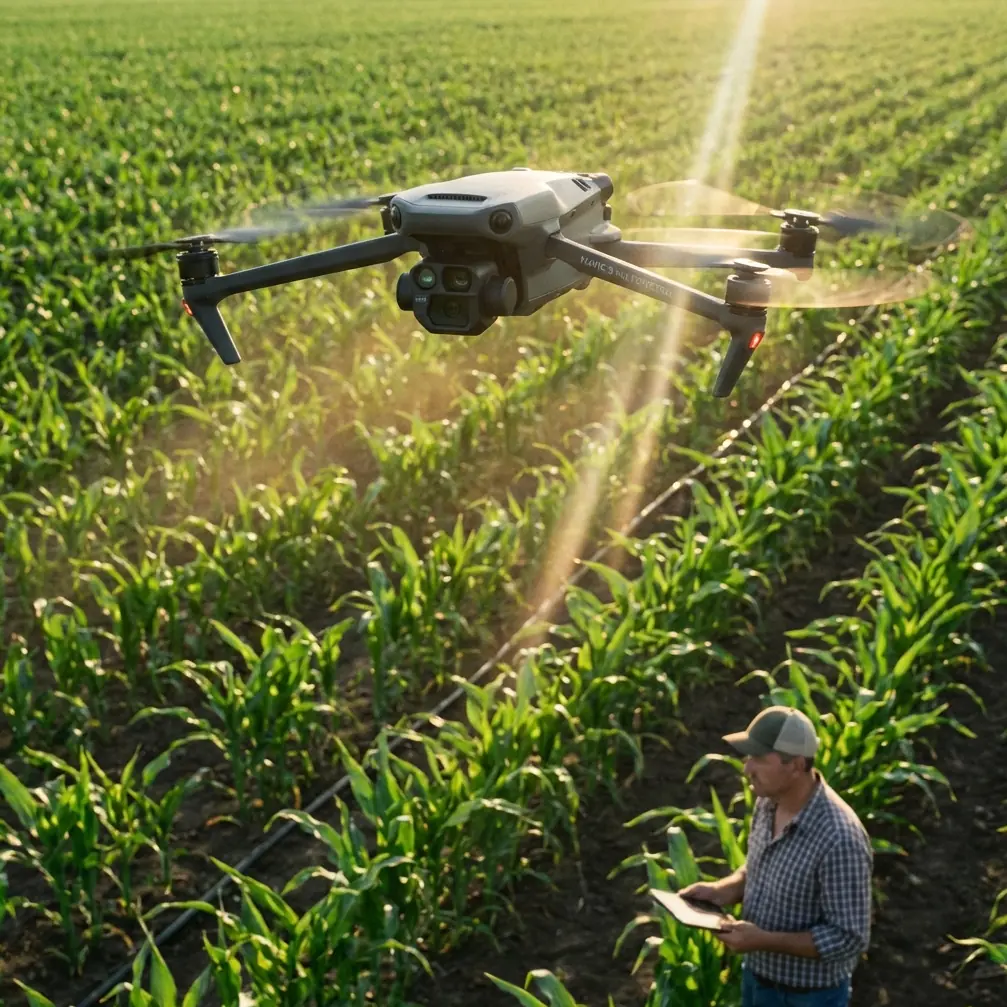
Expert Tracking with Mavic 3M in Coastal Fields: A Field Report from a Changing Low-Altitude Economy
META: A consultant’s field report on using the DJI Mavic 3M in coastal agriculture, with multispectral workflow insights, RTK precision notes, weather handling, and why 2025 low-altitude industry investment matters for operators.
I spent the better part of a recent week walking saline-edge fields near the coast, the kind of ground where crop vigor can shift fast and where weather rarely stays polite for long. The assignment sounded simple enough: track field variability with a Mavic 3M, identify stress patterns before they spread, and give the grower something more useful than broad agronomic guesswork.
What made the job more interesting was the wider backdrop. In the first quarter of 2025, China’s low-altitude economy saw a run of financing events across several segments, from eVTOL and hydrogen electric-control systems to large unmanned cargo aircraft. The deal sizes ranged from tens of millions of RMB into the hundred-million level. One financing item stood out for anyone who works with real deployment rather than slides: on March 28, 2025, Zhidao Technology completed an A+ round worth tens of millions of RMB, exclusively invested by Shanghai Yichen Capital, and expanded beyond its Beijing and Tianjin bases with a new site in Rizhao, Shandong.
That matters more to Mavic 3M users than it might appear at first glance.
Coastal agriculture depends on support infrastructure. Not just aircraft. Bases, service coverage, logistics, repair cycles, battery movement, maritime-adjacent operations, and the ability to keep equipment and expertise close to where work actually happens. When a company expands from Beijing and Tianjin to Rizhao and frames it as improving market coverage and creating a land-sea-air linked production layout, that signals a practical shift in where low-altitude capability is becoming denser. For operators tracking fields in coastal zones, denser capability usually translates into better uptime, faster support, and more confidence in planning repeated missions rather than one-off demonstrations.
That was on my mind when we launched the Mavic 3M just after sunrise.
Why the Mavic 3M fits this kind of work
The Mavic 3M earns its place in coastal crop monitoring because it solves a stubborn problem: you need data with enough fidelity to see stress early, but you also need a platform light and fast enough to use between weather windows. In coastal areas, those windows can close in minutes.
The aircraft’s multispectral payload is the headline feature, but in the field the real value comes from the combination of multispectral capture, visible imaging, and repeatable positioning. Multispectral data helps separate what your eye tends to blur together. A row that looks uniformly green from the levee can already be diverging in plant vigor once you review spectral response across the block. In salt-prone ground, low-lying wet corners, and wind-exposed edges, that separation is where decisions start.
A lot of crews make the mistake of treating multispectral output as the final answer. It is not. It is a triage tool. It tells you where to walk, where to sample, and where to compare irrigation, drainage, nutrient movement, and disease pressure. In a coastal setting, that distinction saves time because not every weak-looking zone is the same problem. Salinity, waterlogging, compaction, and edge exposure can all create similar visual impressions from the truck.
The morning plan, and what changed mid-flight
We had mapped out a standard coverage pattern over several fields bordered by drainage channels and a service road that ran parallel to the shoreline. The intent was to maintain a consistent swath width and collect a clean baseline set before the sea breeze built. Conditions at launch were manageable: light wind, high haze, decent visibility.
About halfway through the second flight, the weather changed in the way coastal weather often does. The wind rose first, then shifted angle. Not dramatic enough to trigger panic, but enough to alter how the aircraft behaved on turns and enough to affect how evenly the platform moved across the lines. If you have spent time with agricultural aircraft, you know why this matters. Even though the Mavic 3M is not a spraying platform, the same environmental instability that causes spray drift concerns on application jobs also affects the quality and repeatability of mapping missions. Drift is a chemical-placement issue; here, the parallel concern is data consistency. Gusts alter ground speed management, yaw corrections, and image geometry if you push too hard through them.
This is where disciplined setup beats optimism.
We had already built the mission around strong RTK behavior because centimeter precision is not a luxury in a field that may need repeated passes over the season. If the RTK fix rate is unstable, your ability to compare one dataset to the next starts to soften, and soft comparisons are dangerous. They create false trends. In our case, the aircraft held position well enough to keep the mission usable even after the breeze picked up. That did not mean ignoring the change. We reduced our tolerance for marginal lines, watched overlap carefully, and made the call to rerun one edge segment rather than pretend the first pass was good enough.
That rerun paid off later. The coastal edge showed a stress signature that would have been easy to dismiss as normal wind exposure if the geometry had been sloppy. Instead, the multispectral layer and the visible imagery lined up cleanly enough to show that the issue tracked a drainage pattern more than a pure wind pattern. Operationally, that changes the grower’s next move. Wind exposure might suggest sheltering strategy or cultivar adjustment. Drainage-linked stress suggests ditch maintenance, water management, or root-zone investigation.
What the low-altitude financing story tells us on the ground
It is easy to treat financing news as background noise. Most operators should resist that instinct. Capital distribution across the low-altitude economy tells you where deployment ecosystems are thickening.
The Q1 2025 picture was broad: anti-drone technologies, eVTOL, hydrogen electric control systems, and large unmanned transport aircraft all drew investment, with companies aiming at low-altitude mobility, hydrogen applications, and logistics transport. Those categories are not the same as precision agriculture, but they influence the same operational environment. When money flows into logistics, mobility, and cross-domain infrastructure, service networks and component ecosystems often improve around them. Better maintenance pathways, stronger regional technical support, more mature supply chains, and faster movement of specialized equipment all tend to follow.
The Zhidao Technology example is especially relevant to coastal field operators because of the Rizhao expansion. Rizhao is not a symbolic inland office. It points toward stronger eastern coastal positioning. Combined with existing bases in Beijing and Tianjin, that creates a more meaningful corridor for support and production capacity. The original framing around market coverage and land-sea-air linkage is not just branding language. In practical terms, it suggests a system designed to serve industries that operate across environmental boundaries, including ports, coastal logistics, marine-adjacent zones, and shoreline agriculture.
For a Mavic 3M user, the message is straightforward: the places where low-altitude operations are becoming more strategically supported are also the places where data-driven field work can scale more reliably. A drone mission is only as useful as your ability to repeat it, process it, act on it, and keep the equipment in service.
What we actually saw in the data
Back at the laptop, the field patterns separated into three categories.
The first was expected coastal stress. Outer margins exposed to steady wind and intermittent salt influence showed lower vigor in a pattern consistent with site history. Useful to document, but not surprising.
The second was management-related variability. There were sections where crop response aligned suspiciously well with equipment access routes and turning zones. That kind of pattern often points to compaction, uneven passes, or timing differences in previous field operations. Here, it raised a side discussion about nozzle calibration on the grower’s spraying equipment. Again, the Mavic 3M is not applying product, but its maps often expose the consequences of poor application uniformity. If a boom or nozzle set is underperforming, the crop eventually tells on it. A multispectral map can become the evidence trail that sends you back to the sprayer shed.
The third category was the most valuable: an irregular low-vigor zone in a lower coastal section that looked minor from ground level but showed stronger definition in the map than anyone expected. That area sat near a drainage transition, and the spectral contrast was sharp enough to justify immediate scouting. The agronomy team found soil conditions that confirmed the map was not exaggerating.
This is the strongest argument for the platform in coastal agriculture. You are not trying to replace agronomists or field managers. You are trying to direct their attention before problems become visible from the cab window.
Mid-flight weather handling is not a minor footnote
People often ask whether the aircraft “handled it well” when weather changes during a mission. That question is too vague. The better question is whether the operation was designed well enough to stay trustworthy after conditions changed.
In our case, the answer was yes, with qualifications.
The aircraft remained stable enough to complete the useful parts of the mission. RTK-backed positioning helped preserve repeatability. We adjusted expectations in real time, reran what needed rerunning, and avoided the temptation to squeeze every acre into one flight just because the drone was still airborne. Coastal work rewards restraint.
If you are coming from spray operations, think of it this way: when wind shifts, you do not focus only on whether the aircraft can physically fly. You think about spray drift, deposition quality, and whether the job still meets the standard you need. Mapping deserves the same discipline. A completed mission that produces doubtful analysis is not efficient. It is expensive confusion.
The practical takeaway for coastal operators
The Mavic 3M is at its best in coastal field tracking when you treat it as part of a larger operating system rather than a flying camera. That system includes:
- strong RTK procedures for repeatable, centimeter-level positioning
- awareness of weather shifts that can affect mission quality before they become obvious safety issues
- attention to swath width and overlap so edge variability is real, not an artifact
- follow-up ground truthing so multispectral patterns lead to decisions instead of speculation
- an understanding that mapped variability may point back to other hardware, including sprayers that need nozzle calibration or revised operating practice
And then there is the industry context. Financing activity in Q1 2025 was not random. Investment from tens of millions to much larger rounds across low-altitude technologies shows that the ecosystem around UAV work is deepening. The March 28, 2025 A+ financing for Zhidao Technology and its new Rizhao base are good examples of what mature deployment thinking looks like: regional expansion, production capacity, and support aligned with real operating geographies. Coastal agriculture sits right inside that trend.
If you work fields near the shoreline, this should change how you think about drone adoption. The question is no longer whether a compact multispectral platform can produce useful crop insight. It can. The better question is whether your region is developing the surrounding support structure to make those insights consistent, scalable, and operationally dependable. More and more, the answer is yes.
I left that site with muddy boots, a weather-stained notebook, and a set of maps the grower could actually use. That, for me, is the standard. Not pretty imagery. Not a one-flight spectacle. Actionable field intelligence gathered under imperfect coastal conditions, with enough positional integrity to repeat the mission and enough context to know why the results matter.
If you want to compare notes on coastal workflows, RTK planning, or multispectral field setup, you can message me here.
Ready for your own Mavic 3M? Contact our team for expert consultation.