
Mavic 3M for Coastal Surveying: A Practical Pre
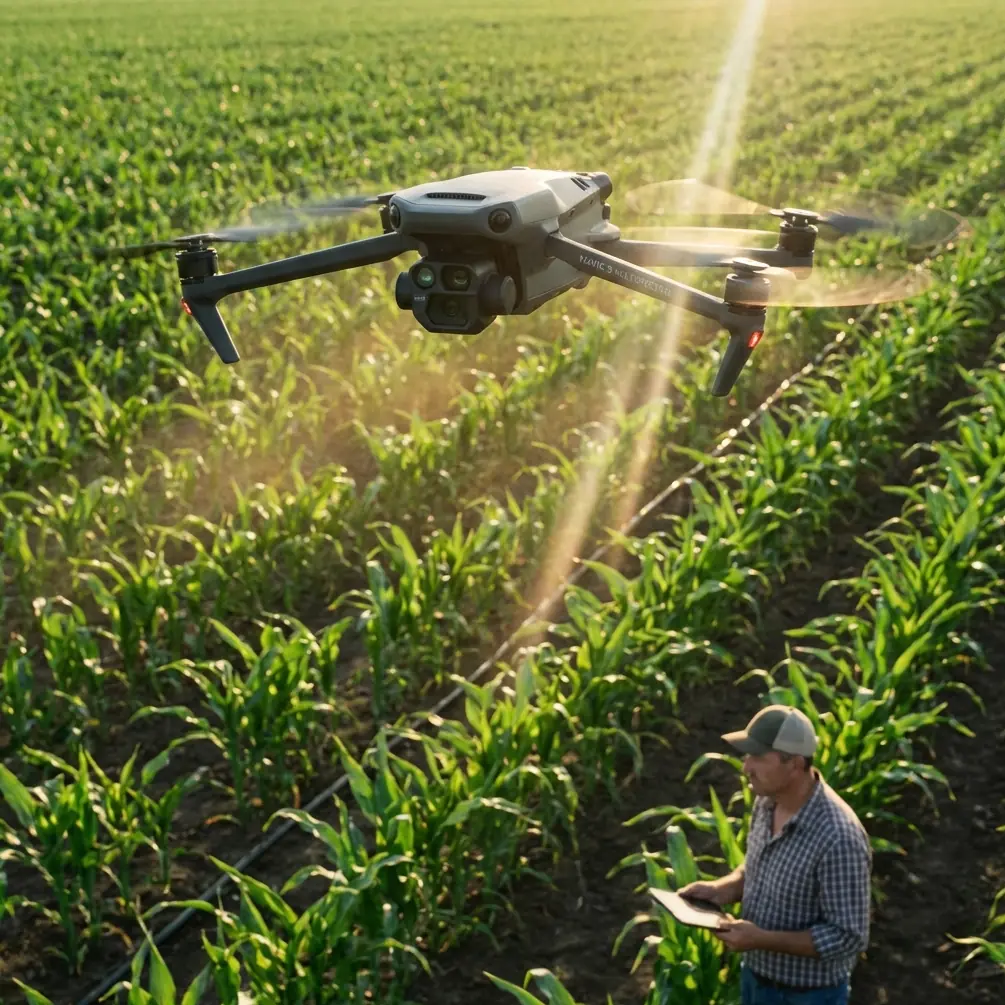
Mavic 3M for Coastal Surveying: A Practical Pre-Flight Workflow That Prevents Bad Data
META: A field-tested tutorial for using Mavic 3M in coastal surveying, with practical pre-flight cleaning, marker logic, coordinate discipline, and why supply-chain scrutiny matters for reliable operations.
Coastal surveying exposes a drone operation in ways inland pilots often underestimate. Salt hangs in the air. Fine grit works into seams. Light reflects off water and confuses visual judgement. Wind shifts fast, and a minor setup mistake on shore can become a messy data set by the time the aircraft reaches the first line.
That is why the Mavic 3M deserves to be approached less like a flying camera and more like a measurement instrument. If your mission is to capture dependable multispectral and mapping outputs near beaches, seawalls, estuaries, or coastal agriculture, the work starts before takeoff. Not with route design. With cleaning.
A small pre-flight cleaning step can directly affect safety features and mission integrity.
Start with the sensors, not the props
Before every coastal mission, I recommend a deliberate wipe-down of the aircraft body, landing surfaces, and especially the vision-related openings and forward-facing surfaces where residue can build up. Salt film is sneaky. It rarely looks dramatic, but it can soften contrast, leave haze on exposed surfaces, and increase the chance that automated positioning or avoidance behavior becomes less confident than it should be.
For a Mavic 3M operating near shore, this matters because the aircraft is often asked to do two contradictory things at once: hold stable geometry for precision mapping while also navigating an environment with glare, moving textures, and airborne moisture. Clean sensors and clean optical surfaces reduce the odds that your platform makes unnecessary corrections or hesitates where it should be smooth.
This is also the right moment to inspect the airframe for any crusting around seams or contact points. Coastal residue is cumulative. Ignore it for a few flights and your maintenance problem becomes an operational problem.
Why a teaching-drone concept is surprisingly useful for Mavic 3M field work
One of the more interesting ideas in the reference material comes from DJI educational drone training, not from a survey manual. In that material, a “jump between challenge cards” function allows a drone to move from one marker to another by using coordinates defined from the first marker’s coordinate system. A sample sequence sends the aircraft from above “Challenge Card 1” to the coordinate (80,0,100), meaning 80 centimeters forward and 100 centimeters high, then transitions to directly above “Challenge Card 2,” rotates to the right by 90 degrees, and lands.
That sounds like a classroom exercise. In coastal surveying, it translates into something much more practical: local reference discipline.
When crews work from dunes, jetties, construction pads, or narrow shoreline access points, they often rush setup. The aircraft launches, RTK is checked, the map starts, and everyone assumes the mission geometry is fine. But if your takeoff point, visual checkpoints, and handoff areas are not mentally tied to a consistent local frame, mistakes creep in. A pilot may think “forward” means inland while the observer is referencing shoreline alignment. A recovery point might be visually obvious but poorly represented in the mission workflow.
The training example reinforces a field habit I like: establish one local reference object or marker near launch and treat it as the anchor for every short reposition, visual check, and emergency landing decision. Even if the mission itself is automated, your crew communication becomes cleaner. “Move 0.8 meters forward and hold 1 meter above the marker” is better than hand-waving over wet sand while wind pushes the aircraft.
The same educational source also notes that if no challenge card is recognized, the system returns -2, while in a flight-map context it can return 11 or 12. Operationally, that is a reminder that machine-readable references are binary in a way people are not. Either the marker is detected correctly, or it is not. In coastal work, where contrast can drop and surfaces can be reflective, never assume a visual reference is being interpreted the way you expect. Build in a quick confirmation step before moving into your main mapping run.
A coastal pre-flight workflow for Mavic 3M
Here is the workflow I use when the mission area is close to saltwater, tidal flats, or coastal farmland.
1. Clean first, power second
Do not power the aircraft and then decide to wipe surfaces. Clean the body, sensor windows, payload-facing surfaces, and landing gear areas before startup. This avoids smearing residue after the system is already active and gives you time to spot corrosion, grit, or moisture intrusion.
This one habit protects more than image quality. It supports stable behavior in automated takeoff, return, and low-altitude transitions.
2. Create a local marker logic at launch
Even though the Mavic 3M is not the TT educational platform, the marker-based lesson still applies. Place or identify a visible launch reference that the whole crew agrees on. In cramped coastal sites, this can be the difference between a smooth recovery and a rushed correction.
Use it to define plain-language references:
- launch point
- hover verification point
- contingency landing area
- battery swap area
The educational example’s (80,0,100) movement is useful here because it reminds pilots to think in offsets, not vague descriptions. A precise offset mindset reduces confusion when the wind is noisy and the shoreline is visually busy.
3. Confirm your coordinate mindset before RTK-dependent work
The user scenario here is surveying venues in coastal areas, where centimeter-level expectations are common. If your operation depends on centimeter precision, then RTK Fix rate is not just a technical metric in the app. It determines how much confidence you can place in edge boundaries, vegetation comparisons, drainage interpretation, and repeat-pass alignment.
This matters especially for multispectral work. A beautiful map with shaky positional consistency becomes hard to compare over time. Near coastlines, where erosion, standing water, salt stress, and vegetation changes can be subtle, repeatability is often more valuable than a single dramatic image.
So before flying:
- verify RTK fix stability at the launch area
- confirm no obstructions are biasing your setup
- avoid starting the mission the moment the system briefly reports good status if it has not settled
Centimeter precision is only meaningful when it is stable enough to trust.
4. Check mission edges against wind, not just map boundaries
Coastal wind can make a neat polygon on screen behave badly in practice. If the mission edge ends over reflective water, a rock berm, or a narrow strip beyond your safe visual comfort zone, trim it before launch. Mapping discipline is not about collecting every possible pixel. It is about collecting usable data with consistent geometry.
For multispectral surveys, consistency wins. If your overlap, speed, and track spacing degrade because the aircraft is fighting a crosswind segment over a poor visual background, your final stitched result can suffer in exactly the area you most wanted to analyze.
5. Treat surface residue as a recurring risk during battery changes
This is where coastal teams lose time. The first battery is clean. The second has sand on the gloves, salt on the table, and a damp case sitting half-open. Repeat your quick wipe and visual inspection at each battery swap. It takes a minute and prevents a mid-day decline in aircraft behavior that people often misdiagnose as “just wind.”
What obstacle-detection research teaches survey crews
Another reference in your source set is a research paper on stereo vision running on a lightweight embedded platform. The exact aircraft is not the Mavic 3M, but the engineering takeaway is relevant. The system used a quad-core 1.7 GHz ARM board weighing under 50 grams, with stereo cameras running at 120 frames per second and reliable detection out to about 5 meters, with 4.8 meters used as the single-disparity distance.
Why should a coastal survey operator care?
Because it illustrates the hard limits of onboard perception. Even fast embedded systems with carefully tuned stereo processing are bounded by range, scene quality, and false positives or false negatives. The paper explicitly looked for both missed obstacles and incorrect detections by comparing outputs and Euclidean distances between observed points.
That is not just an academic detail. It is a warning against overconfidence.
In coastal environments, obstacle perception can be complicated by:
- glare from wet surfaces
- low-texture sand
- moving water
- thin posts, wires, or temporary site materials
- haze and salt mist
So while Mavic 3M operators benefit from advanced sensing and safety features, smart crews still fly with conservative margins around seawalls, staging equipment, temporary fencing, and elevated site structures. If the mission demands low-altitude passes near uneven terrain or infrastructure, trust your planning more than your assumptions about what the aircraft will always detect.
Clean sensors help. Conservative geometry helps more.
How this applies to coastal vegetation and venue surveying
The reference context points to “surveying venues in coastal,” which I read as sites that may include coastal facilities, managed landscapes, event grounds near shore, or agricultural plots affected by saline conditions. This is where the Mavic 3M’s multispectral capability becomes genuinely useful.
In these sites, the visual layer alone can be deceptive. Turf can look healthy from eye level while stress is beginning in low-lying sections. Managed plantings can be affected by salt exposure patterns that are not obvious until you compare zones consistently over time. Drainage issues can appear and disappear with tide, irrigation timing, or recent weather.
That is why your field method matters as much as the payload:
- clean aircraft surfaces so the sensing stack starts from a good baseline
- hold a consistent local reference at launch
- verify RTK stability before committing to the run
- manage wind and edges conservatively
- repeat the inspection at every battery swap
These are not glamorous steps. They are the difference between “we flew the site” and “we produced a defensible survey.”
Supply chain scrutiny matters more than many operators realize
One news reference describes a broader industry shift discussed at XPONENTIAL 2026: the U.S. drone sector moving from prototype culture toward industrial-scale production, with heavier scrutiny on suppliers and the drone supply chain.
Even though that roundtable was framed around a different segment of the industry, the civilian lesson is straightforward. Professional drone operations are no longer judged only by airframe performance. They are judged by consistency, supportability, replacement timelines, firmware confidence, and parts traceability.
For a Mavic 3M operator doing scheduled coastal surveys, that changes procurement and maintenance behavior. You need confidence that:
- replacement consumables arrive on time
- field accessories are consistent
- maintenance routines are documented
- your operation is not exposed to random component variability
Coastal flying is unforgiving. When your environment adds corrosion, residue, and wind stress, supply-chain reliability becomes an operational metric, not an accounting detail.
If you are building a repeatable workflow for coastal venue surveys and want a second set of eyes on your setup, mission design, or maintenance routine, you can message a field consultant directly here.
Common mistakes I see in coastal Mavic 3M deployments
Confusing image capture with survey discipline
A clean orthomosaic is not automatically a reliable survey product. If the launch procedure is sloppy, the whole chain is weaker.
Skipping the second cleaning cycle
The battery swap is where contamination creeps in. Most teams inspect less as the day goes on, not more.
Assuming automated sensing will solve bad approach geometry
It will not. The obstacle-detection research in your references is a good reminder that embedded perception has limits, especially near ambiguous surfaces.
Ignoring local reference language within the crew
The educational “challenge card” concept proves how useful explicit offsets and marker-relative movement can be. It is simple, and it prevents avoidable confusion.
Chasing maximum coverage on windy edges
In coastal mapping, the outermost strip is often the least trustworthy if wind or glare is working against you.
A simple final checklist before launch
For Mavic 3M coastal work, I would keep the checklist this lean:
- Clean external surfaces and sensor-facing areas.
- Inspect for salt, grit, or moisture accumulation.
- Define one local ground reference for crew coordination.
- Confirm RTK Fix rate is stable, not momentary.
- Review mission edges against real wind conditions.
- Brief recovery and contingency offsets in plain language.
- Repeat inspection at every battery change.
That is the kind of workflow that protects data quality without turning a field day into ceremony.
The Mavic 3M is fully capable of excellent coastal survey results, but the aircraft does not compensate for loose field habits. The best operators know that precision begins on the ground, with a clean airframe, a clear reference system, and a crew that understands exactly what “good enough” is not.
Ready for your own Mavic 3M? Contact our team for expert consultation.