
Surveying Complex Coastlines with the Mavic 3M
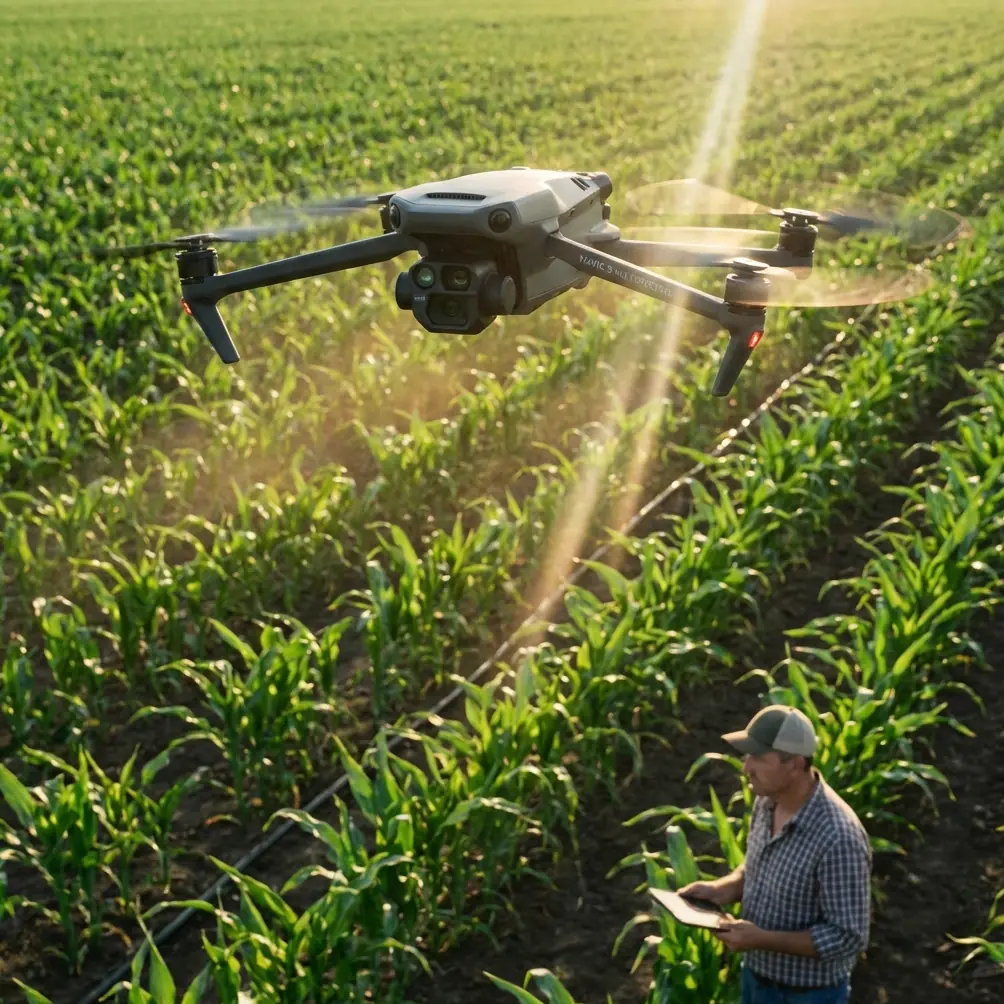
Surveying Complex Coastlines with the Mavic 3M: What Actually Matters in the Field
META: A field-driven look at using the Mavic 3M for complex coastline surveying, combining multispectral insight, elevation products, and practical workflow lessons for challenging terrain.
Coastline surveying looks straightforward on a map. In the field, it rarely is.
A rocky estuary, a tidal flat, a vegetated embankment, a narrow access road, and changing light over water can turn a simple mission into a messy one. Add steep relief, wet ground, and the need to produce usable mapping outputs quickly, and the gap between “drone flight” and “survey result” becomes obvious.
That is exactly where the Mavic 3M deserves a more careful discussion.
Most people approach this aircraft through an agriculture lens because of its multispectral payload. That makes sense, but it misses a larger point. In complex coastal terrain, the real value of the Mavic 3M is not just that it captures multispectral imagery. It is that it helps operators connect surface condition, vegetation response, and geospatial structure in one compact workflow. For consultants, environmental teams, and infrastructure managers, that combination can be more useful than a standard visual survey alone.
I’ve seen this play out on shoreline jobs where the brief sounded simple: map the edge condition, document vegetation stress, and identify areas where water interaction was accelerating change. The terrain was fractured and uneven, with sections of reed cover, exposed sediment, and man-made drainage features. Mid-flight, a cluster of shorebirds lifted off from a marsh pocket that had been visually difficult to distinguish from the surrounding mudflat. The drone’s sensor suite gave enough context to adjust the route without losing the data objective. That kind of moment matters. Coastal surveying is never only about coverage. It is also about reading the site fast enough to adapt.
The coastal problem is not just geometry
Traditional drone mapping conversations often begin and end with orthomosaics and terrain models. Those outputs still matter. In fact, one of the strongest established advantages of UAV surveying is the ability to quickly generate DEM, DOM, and DLG products from aerial data. That workflow has long been recognized as one of the most mature civilian uses of drones because it shortens implementation cycles and provides high-precision surface data that manual field methods often struggle to deliver continuously or intuitively.
For coastlines, though, geometry is only half the story.
A shoreline is a living boundary. Soil moisture shifts. Salinity stress appears unevenly. Vegetation density changes with tidal influence. Drainage channels migrate. Sediment composition can vary over short distances. A simple RGB dataset may show where something looks different, but not always why it is different.
This is where the Mavic 3M’s multispectral character becomes operationally significant.
The reference material behind hyperspectral and spectral soil analysis points to a long scientific history here. Since the 1920s, researchers have used modern spectral analysis to study soil characteristics, and visible, near-infrared, and mid-infrared methods are already widely applied in soil science. One especially useful detail is that 350–2,500 nm hyperspectral reflectance data can reveal subtle differences in soil physicochemical parameters. That does not mean the Mavic 3M replaces a full hyperspectral lab-grade workflow. It does mean the core principle is proven: spectral response contains surface information that pure visual imagery can miss.
For coastal survey teams, that matters in practical terms. If your mission is not merely to draw the shoreline but to understand stress, instability, or transition zones, multispectral data becomes a decision layer rather than a decorative extra.
Why soil and water science matter to a coastline survey
Two reference points stand out.
First, the source material highlights soil available potassium as a meaningful indicator of a soil’s capacity to supply potassium to crops, and also notes that potassium imbalance can disrupt broader ecological cycling. On the surface, that sounds agricultural. On a coastline, it points to something bigger: shoreland condition is tied to chemistry, vegetation response, and environmental stability. You may not be running a crop nutrition program on a seawall embankment, but you are often evaluating vegetated edges, disturbed soils, or reclaimed land where nutrient dynamics and moisture patterns affect surface resilience.
Second, the same source points to chlorophyll-a estimation in water bodies as a major application area because it serves as a useful biological indicator of inland water nutrient status. Again, translate that into coastal operations and the relevance is immediate. Estuarine margins, lagoons, outfalls, and sheltered inlets often need both land-edge mapping and water-condition observation. A survey team working with the Mavic 3M is not just documenting a line on a chart. They may be documenting interaction between shore cover and adjacent water quality signals.
This is why the Mavic 3M fits coastline work better than many assume. It sits at the intersection of mapping and environmental interpretation.
The real workflow advantage: fast products with richer context
A coastline project usually demands two things at once:
- A defensible spatial product
- A field interpretation that can survive expert review
The first requirement is where drone photogrammetry remains essential. The reference material from the water resources sector is clear: UAVs can rapidly acquire aerial images and, with processing such as aerial triangulation and automatic photo stitching, produce DEM, DOM, and DLG outputs efficiently. It also notes that UAV implementation cycles are short and that the resulting data can correct the weaknesses of manual measurement, especially where human surveys are slow, fragmented, or difficult to visualize.
That description could have been written for coastline work.
Complex terrain along shorelines often punishes ground crews. Mud, unstable slopes, vegetation barriers, and water access gaps create discontinuities in traditional measurements. A compact platform like the Mavic 3M reduces that friction. It can move from embankment to wetland fringe to exposed intertidal zone without requiring multiple sensor packages and multiple mobilizations.
The second requirement, interpretation, is where operators often underperform. They collect beautiful maps and then provide weak insight. A coastline orthomosaic without spectral reasoning can miss the early signatures of vegetation stress, sediment transition, or drainage anomalies. That is a missed opportunity.
With the Mavic 3M, multispectral capture helps bridge that gap. Not as a substitute for field truthing, but as a way to direct it more intelligently.
A note on precision and “centimeter precision” claims
The user scenario around coastlines usually brings up RTK fix rate and centimeter precision. Fair enough. But practitioners should stay disciplined here.
Centimeter-level positioning is only valuable if the rest of the workflow is equally controlled. In coastal terrain, that means flight timing relative to tide stage, reliable control strategy where possible, careful overlap planning, and realistic expectations over reflective water and low-texture surfaces. The aircraft can support high-accuracy mapping workflows, but shoreline environments are notoriously unforgiving. Water edges distort perception. Wind changes quickly. Vegetation can move enough to degrade edge definition.
So when someone asks whether the Mavic 3M can deliver precise coastal survey data, the honest answer is yes—with conditions. Precision is not a checkbox. It is a chain.
What the references reveal about limitations—and why that matters for M3M users
One of the more valuable parts of the source material is that it does not pretend drone operations are frictionless. It points to limitations in industry standards, regulatory systems, safety, industrial supply chain maturity, and key technologies. That is not abstract bureaucracy. For Mavic 3M users on coastline projects, it has daily consequences.
Standards gaps affect how results are compared from one operator to another.
Regulatory inconsistency affects where and when coastal flights can happen.
Key technical limits affect battery planning, communication stability, and data processing confidence.
Those issues are especially visible in shoreline jobs because coastlines tend to combine environmental sensitivity, public proximity, reflective surfaces, and weather instability.
This is also why a responsible consultant does not oversell single-flight certainty. The Mavic 3M is highly capable, but coastline surveying still benefits from layered validation: control points where practical, repeated flights where change detection matters, and interpretation backed by field notes rather than image-only assumptions.
Spectral processing: where the smart operators separate themselves
There is another reference detail that deserves more attention.
The source material on soil spectroscopy explains that derivative processing can help identify curve inflection points and extrema, but it can also amplify noise and reduce modeling accuracy by obscuring the waveform. It specifically notes that derivative spectra may remove baseline and low-frequency noise while simultaneously introducing high-frequency noise. By contrast, wavelet transform methods are highlighted for their strength in denoising and data compression, and some studies found they improved correlation and simplified models.
Why should a Mavic 3M coastline operator care?
Because the biggest mistake in environmental drone work is assuming that more spectral processing automatically means better insight. It does not. Coastal data is already noisy. Water glare, wet soil reflectance, mixed vegetation, and changing illumination create conditions where aggressive processing can produce false confidence. The operational lesson is simple: if you are using multispectral data from the Mavic 3M to infer shoreline condition, your processing choices matter as much as your flight plan.
That is the difference between a map that looks sophisticated and a dataset that supports an engineering or environmental decision.
Where Mavic 3M makes the most sense on coastal jobs
The strongest use cases are not generic “survey everything” missions. They are targeted tasks where geometry and surface response need to be understood together:
- Vegetated embankment condition assessment
- Shoreline erosion pattern documentation
- Wetland boundary and vigor review
- Drainage channel identification near the coast
- Reclaimed land monitoring
- Outfall-adjacent surface stress observation
- Baseline mapping for repeat seasonal comparison
This is also where related operational concepts like swath width and RTK fix reliability start to matter less as marketing terms and more as planning variables. A wider swath may improve efficiency, but only if overlap remains sufficient for shoreline edges and mixed terrain. A strong fix rate matters, but only if signal continuity holds through the actual terrain and mission geometry.
Even terms that belong more naturally to spraying operations—such as spray drift or nozzle calibration—are useful reminders here by contrast. The Mavic 3M is not an application platform for coastal chemical work in this context. Its role is diagnostic. It tells you where variation exists and how it may be spatially organized. It helps you inspect before others intervene.
Field discipline beats feature obsession
When I evaluate a coastline workflow built around the Mavic 3M, I look for a few things before I care about software screenshots:
- Did the operator choose the right tide window?
- Was the route built around terrain and habitat sensitivity?
- Were spectral objectives defined before takeoff?
- Was the final output tied to a practical question, not just a pretty map?
- Did the team understand the limits of spectral interpretation over wet, mixed surfaces?
The wildlife encounter I mentioned earlier is a good example of why this matters. On paper, that marsh section was just another polygon in the mission area. In reality, it was a living zone where bird movement, shallow water, and vegetation texture intersected. The drone’s sensors helped preserve awareness, but the operator still had to make the judgment call. That is the future of good UAV surveying in sensitive coastal terrain: compact aircraft, richer sensing, and better human decisions.
If your team is evaluating whether the Mavic 3M fits a shoreline project, the right question is not “Can it map the coast?” Almost any serious mapping drone can do some version of that.
The better question is this: can it help you understand what the coast is doing?
In many civilian survey and environmental workflows, the answer is yes. Especially when you combine fast aerial product generation with multispectral interpretation and realistic processing discipline.
If you need help thinking through sensor fit, mission design, or output structure for a specific site, you can message a coastal survey workflow specialist here.
Ready for your own Mavic 3M? Contact our team for expert consultation.