
Mavic 3M in Dusty Wildlife Spray Operations
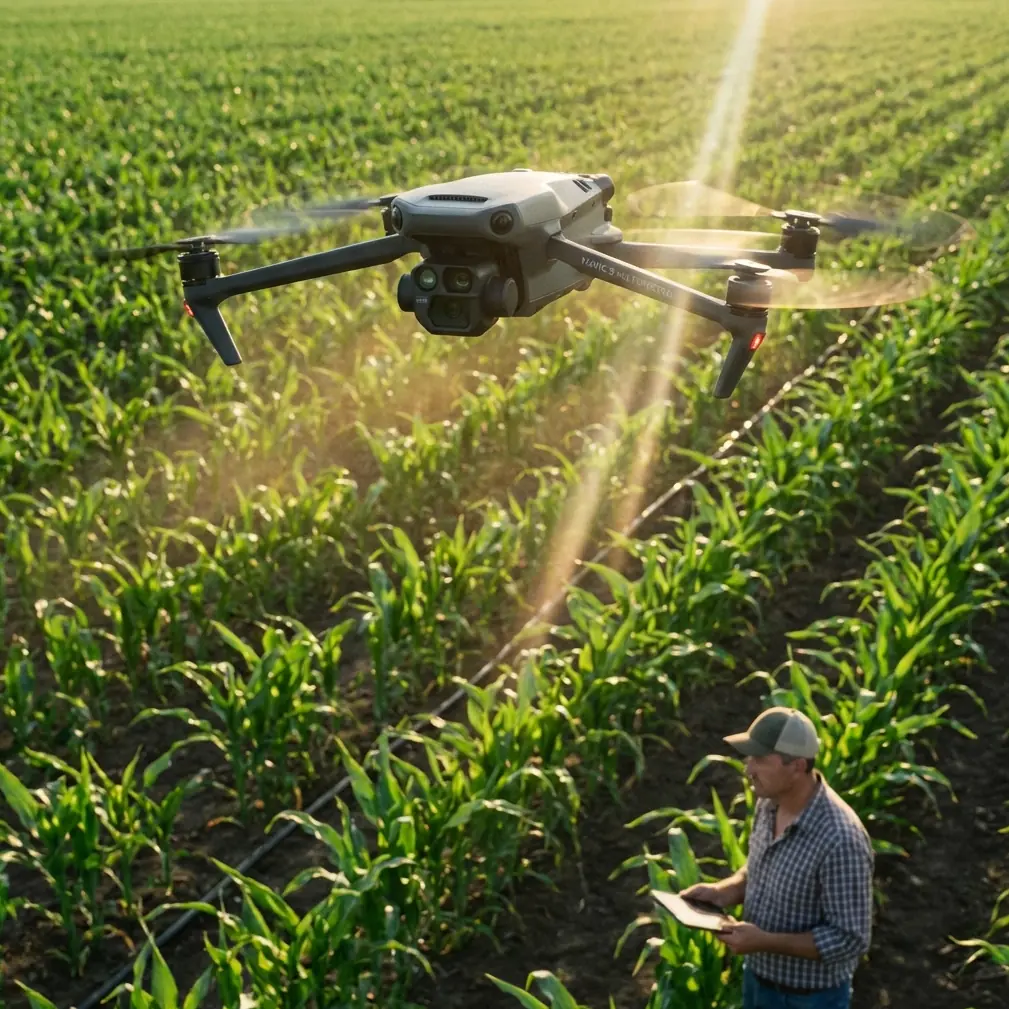
Mavic 3M in Dusty Wildlife Spray Operations: What Flight Height Really Changes
META: A field-based analysis of Mavic 3M use in dusty wildlife spraying conditions, with practical guidance on flight altitude, multispectral value, redundancy thinking, and data capture efficiency.
When operators talk about spraying in dusty wildlife environments, they usually jump straight to payload, droplet size, or coverage rate. That misses the real hinge point. In these conditions, flight altitude becomes the variable that quietly controls almost everything else: drift behavior, canopy penetration, image reliability, route consistency, and the margin you have when visibility and surface contrast degrade.
For teams evaluating the Mavic 3M for this kind of work, that matters more than any glossy spec sheet summary. The aircraft is not a sprayer in the dedicated agricultural sense, but it can sit at the center of a smarter civilian workflow: mapping target habitat, identifying treatment zones, documenting pre- and post-application conditions, and guiding low-risk, precision field decisions around spray operations in challenging terrain. In dusty wildlife management scenarios, especially where operators are trying to balance treatment effectiveness with minimal off-target impact, the Mavic 3M’s value is tied less to raw endurance and more to how well it supports disciplined altitude control and repeatable site intelligence.
Why dusty wildlife spraying is harder than standard crop work
Dust changes the air column. It reduces visual clarity, softens terrain definition, and can interfere with an operator’s ability to judge true height over irregular ground. Wildlife zones add another layer: treatment blocks are often fragmented, access is limited, and the target area may sit near scrub, fencing, erosion features, or uneven clearings rather than clean agricultural rows.
That combination makes “fly a bit higher to stay safe” a tempting habit. It also creates side effects.
Raise altitude too much and you increase the opportunity for spray drift, especially when dust already signals loose surface conditions and unstable near-ground air movement. Stay too low without a disciplined method and you may struggle to maintain a consistent swath width over variable topography, particularly near brush lines or small rises. The operational sweet spot is rarely guessed correctly in the field. It has to be designed.
This is where Mavic 3M becomes useful before the first liter is ever released. Its role is to map terrain transitions, detect vigor differences with multispectral capture, and support route planning that accounts for height changes instead of forcing a single crude altitude across the whole block.
The overlooked lesson from a simple height-limiting exercise
One of the most practical reference points for safe height control comes from an educational DJI drone training example, not from a marketing brochure. In that example, the aircraft uses both a TOF height sensor and a barometric altimeter to enforce a maximum flight height of 250 centimeters. The program logic is straightforward: once the TOF value exceeds 250 cm, or the barometric reading crosses the calculated threshold, the drone stops climbing and then lands. The sample baseline pressure-derived height begins at -56.92 meters on the ground, producing a max-height trigger around -54.42 meters after adding 2.5 meters.
That may sound like a classroom exercise. In reality, it captures a deeper operational principle that matters in dusty wildlife work: one height source is never enough when your environment is messy.
Dust, uneven terrain, and visual ambiguity all create conditions where altitude assumptions fail. The significance of using two independent references—TOF and barometric data—is not the exact number 250 cm. It is the redundancy mindset. In a wildlife spray support mission, that same logic translates into building your route and flight checks so that one misleading input does not push the aircraft into an unsafe or ineffective operating band.
For Mavic 3M users, the practical takeaway is this: optimal altitude is not merely “low” or “high.” It is verifiable. If your route planning assumes a constant height but your terrain rolls, or if your visual estimate differs from your sensor-based profile, your spray support map becomes less trustworthy and your drift assumptions become weaker. Dust punishes lazy altitude management.
What altitude should you actually aim for?
There is no universal single-number answer, because nozzle setup, application platform, vegetation density, and local regulation all matter. But in dusty wildlife treatment areas, the best altitude strategy usually starts with a split workflow:
- Use the Mavic 3M at a conservative reconnaissance height first to create a reliable terrain and condition picture.
- Then define lower, treatment-relevant operating bands only after you understand ground variation, vegetation structure, and obstacle distribution.
The field mistake is trying to derive treatment altitude from intuition before collecting a site model.
A good reconnaissance altitude is one that remains high enough to maintain clear lateral awareness in dusty air but low enough to preserve meaningful spatial detail in multispectral and visual imagery. The point is not simply coverage. It is decision quality. You want enough resolution to identify where the actual treatment edge should be, where drift-sensitive borders exist, and where the ground profile would force a change in effective height above target.
In practical terms, if the surface is throwing visible dust and the habitat is fragmented, the safer planning approach is to map in tighter blocks with altitude adjusted to terrain, rather than pushing broad uniform passes. Mavic 3M is strongest when used to refine these micro-decisions.
Why multispectral matters more here than in clean farm fields
In a conventional field, visual cues often tell you where a crop problem starts and stops. In wildlife management terrain, the boundaries are usually less obvious. Dusty surfaces can wash out contrast. Mixed vegetation can hide stress signatures. Bare ground and scrub can sit side by side with target species.
That is why the Mavic 3M’s multispectral capability earns its place in this scenario. Multispectral data helps separate vegetation response patterns that a standard RGB-only inspection may flatten or miss. For wildlife spraying programs, that can support cleaner treatment zoning: not just where biomass exists, but where plant condition suggests intervention urgency, habitat change, or retreatment need.
The significance is operational, not academic. Better zoning can reduce unnecessary application in low-value or non-target patches. That means lower drift exposure around sensitive edges and fewer wasted passes over ground that does not need treatment.
Centimeter-class repeatability also becomes more meaningful when treatment blocks must be revisited. If the team is checking whether prior application changed vegetation response in a dusty corridor or scrub edge, consistency of capture geometry matters. Readers often focus on RTK fix rate as a headline number, but the real value lies in whether repeat missions align tightly enough to support confident comparison. In wildlife spraying support, that consistency can be more useful than raw area covered per flight.
A second lesson from scanning workflows: speed only matters when data stays usable
Another reference source offers an unexpectedly relevant comparison. In a three-dimensional scanning project covering 11 townships, around 100 kilometers of road, and roughly 4,000 houses, the documented advantage was not just convenience. The report states that 3D scanning achieved work efficiency about 10 times that of conventional methods. It also emphasizes data completeness, reduced manual labor, and the ability to handle dense, uneven built environments.
Why bring this into a discussion about Mavic 3M and dusty wildlife spray support? Because the same principle applies: fast capture is only valuable if it preserves actionable completeness.
Dusty field operations tempt teams to rush. Visibility windows may be short. Access may be awkward. Wildlife sensitivity may limit time on site. Under pressure, a quick visual overflight can feel adequate. Often it is not. If your initial dataset misses shallow depressions, edge obstacles, or subtle vegetation variation, your later application plan may be efficient on paper and poor in execution.
The 10x efficiency benchmark from scanning work is useful as a mindset check. Modern aerial and spatial capture systems can outperform legacy field methods dramatically, but only when the workflow is structured around complete information, not just quick collection. For Mavic 3M, that means disciplined flight planning, clean overlap, sensible altitude selection, and a clear objective for every sortie.
Redundancy thinking is not optional in dust
The educational drone source also discusses redundancy more broadly: if one motor fails, the remaining motors may still allow a controlled descent; if a power circuit fails, another circuit can maintain function; if one flight controller or battery path has an issue, backup architecture can preserve safe operation.
No one should stretch that example beyond its context. But the operational significance is plain. In dusty, low-contrast environments, operators should think in layers of protection rather than singular confidence points.
For Mavic 3M missions supporting civilian wildlife spray programs, that means:
- Redundant awareness of altitude, not just visual judgment.
- Redundant confirmation of target boundaries, not just a single RGB pass.
- Redundant mission logic, including return thresholds and conservative battery margins in dust and heat.
- Redundant site understanding through pre-mission and post-mission comparison.
That style of operation is how you keep precision credible when conditions are working against you.
A practical case pattern for Mavic 3M in dusty wildlife treatment zones
Let’s make this concrete.
Imagine a wildlife vegetation control program in a dry reserve fringe where invasive growth is spreading along shallow drainage lines. The soil is loose. Vehicle movement kicks up dust. The target patches are irregular, with scrub islands and bare strips between them. A broad-brush spray plan would almost guarantee uneven coverage and unnecessary drift near non-target edges.
A stronger workflow would look like this:
Phase 1: Reconnaissance mapping with Mavic 3M
Fly the area in structured blocks at a height selected for stable image quality and obstacle visibility, not maximal area coverage. Use multispectral outputs to distinguish stressed target vegetation from non-target cover and to reveal subtle vigor transitions that RGB alone may hide.
Phase 2: Terrain-aware treatment planning
Use the map to identify where effective height above target would change due to micro-topography. This is where the altitude lesson becomes practical. The goal is not “keep the drone at one height.” The goal is “keep the treatment platform within a consistent effective band above the target surface.” That distinction reduces drift variability and improves swath consistency.
Phase 3: Border refinement
Review edges where dust, scrub, or broken ground could distort line-of-sight judgment in the field. Tighten those boundaries using the captured dataset rather than relying on memory from a windshield survey.
Phase 4: Repeatable monitoring
After treatment, revisit with matching geometry as closely as possible to assess vegetation response. This is where centimeter-level positioning discipline and a strong RTK fix rate matter operationally, because you want comparison reliability, not loosely similar photos.
If a team needs help structuring that sort of workflow around local conditions, a field discussion can be more useful than another checklist—this is the most direct way to talk through edge cases: https://wa.me/85255379740
The altitude insight most teams learn too late
The best flight altitude in dusty wildlife spray work is the lowest altitude that still preserves safe obstacle margin, stable image quality, and consistent route execution across terrain variation.
Not the lowest possible. The lowest reliable.
That difference sounds small, but it changes outcomes. Fly unnecessarily high and you weaken the precision case for the whole operation. Fly aggressively low without accounting for terrain, dust, and sensor confidence, and you create inconsistency that can be just as damaging.
The 250 cm training example is useful because it forces disciplined threshold thinking. The scanning case is useful because it proves that better spatial capture can transform field productivity—up to 10 times compared with conventional work—when the workflow is designed around complete, usable data. Together, those references point to the same truth for Mavic 3M users: precision comes from controlled information, not from speed alone and not from intuition alone.
For wildlife spraying in dusty environments, Mavic 3M is most valuable when it serves as the aircraft that helps you choose the right altitude before treatment starts, verify that your swath logic fits the terrain, and document whether the intervention actually worked. That is a far more serious role than simply “flying over the site.” It is the difference between an airborne camera and a decision system.
Ready for your own Mavic 3M? Contact our team for expert consultation.