
Mavic 3M in the Vineyard at First Light: A Field Report
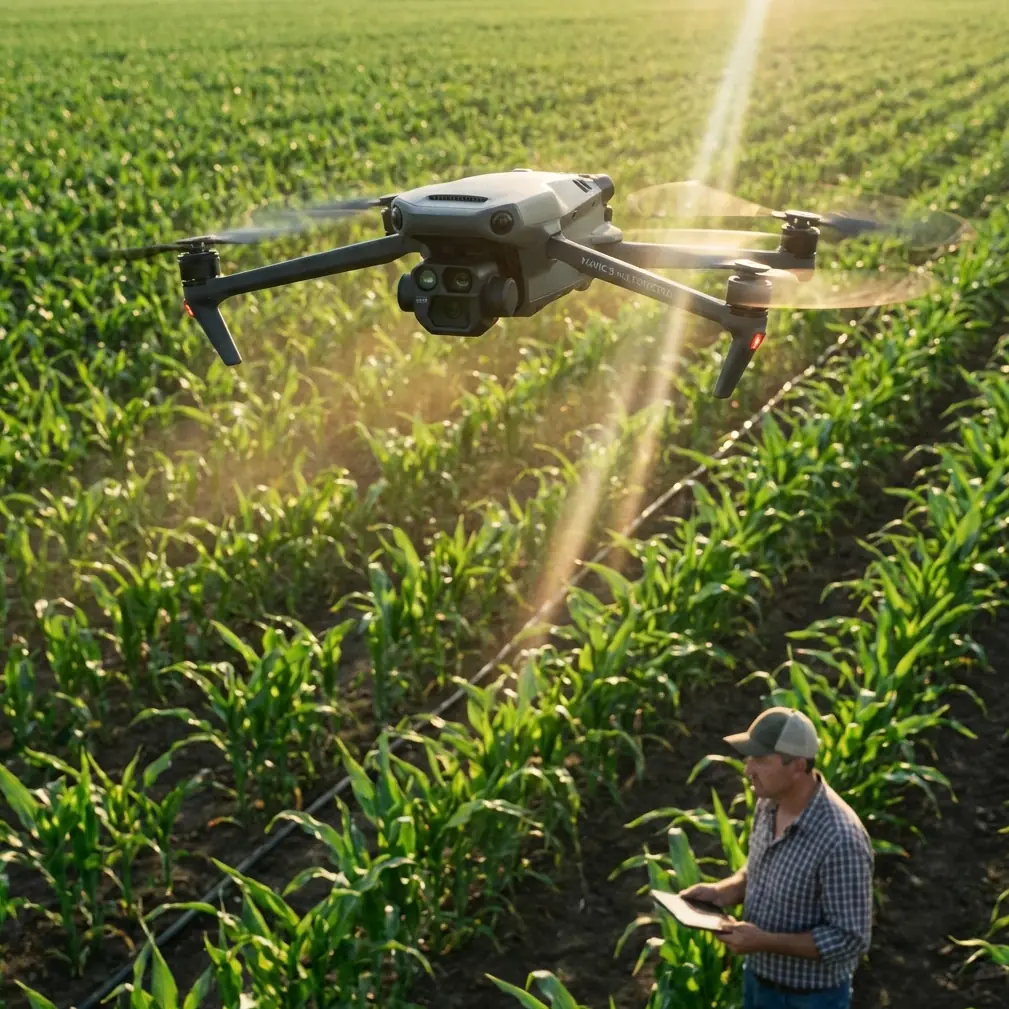
Mavic 3M in the Vineyard at First Light: A Field Report on Precision, Training, and Low-Light Spray Discipline
META: Field report on using Mavic 3M thinking for vineyard spraying in low light, with practical insight on multispectral workflows, spray drift discipline, RTK precision, operator training, and why new low-altitude university programs matter.
The most revealing part of a low-light vineyard mission is not the takeoff. It is the moment just before it.
Rows are still dark. Moisture hangs in the canopy. The air is often calmer than it will be an hour later, which helps with spray drift control, but visibility is less forgiving and every weakness in planning gets exposed. In those conditions, a Mavic 3M-centered workflow becomes less about gadget admiration and more about disciplined decision-making: canopy variability, route confidence, obstacle awareness, nozzle calibration on the spray side of the operation, and whether the crew can trust centimeter-level positioning when the terrain starts to fold under the vines.
I want to frame this as a field report, not a brochure. Because readers looking at the Mavic 3M for vineyard work already know the headline idea: multispectral data can sharpen agricultural decisions. What matters is how that capability fits into a real dawn spraying context, where timing, training, and sensor trust all intersect.
Why the vineyard shift starts before sunrise
Low-light spraying in vineyards has a practical logic. Winds are often lighter. Temperatures are lower. Evaporation pressure is reduced. Drift risk can be easier to contain if the operator respects the weather window and the aircraft path is stable. But “easier” is not the same as easy.
This is where Mavic 3M thinking is especially useful. Its role is not to replace agronomy or spray expertise. Its role is to reduce guesswork before liquid ever leaves a tank. Multispectral imaging can identify uneven vigor, weak rows, stressed edges, and blocks that should not be treated as if they are identical. In a vineyard, that matters because swath width decisions and application consistency are only as good as the assumptions behind them.
A block with patchy growth invites over-application in sparse sections and under-coverage in dense ones. A block mapped properly gives the spray crew a different kind of confidence. Not blind confidence. Structured confidence.
The lesson hidden in a university admissions story
One of the more telling industry signals this year did not come from a hardware launch. It came from higher education in Heilongjiang, where universities added 77 new undergraduate majors, including programs such as low-altitude technology and engineering and aircraft operation and maintenance engineering. At the same time, five universities in the province added artificial intelligence majors, and Harbin Institute of Technology moved first nationally on undergraduate specialties such as embodied intelligence.
That may sound far removed from a vineyard at dawn. It is not.
Those additions tell us the UAV sector is maturing beyond pilot skill alone. The industry now needs people who can think across airframe behavior, operational reliability, sensor interpretation, and AI-assisted workflows. For Mavic 3M operators, that shift is operationally significant. A multispectral platform in agriculture is only as effective as the team interpreting the data, maintaining the aircraft, validating route accuracy, and integrating findings into spray decisions.
In other words, vineyards no longer just need drone pilots. They need low-altitude systems professionals.
That distinction becomes critical in low-light work. The crew member reviewing terrain overlap, the technician checking firmware behavior, and the agronomy lead reading plant stress patterns are all part of the same risk-control chain. The universities are responding to that reality. So should vineyard operators.
A fox in Row 18
On one recent pre-sunrise pass, before the spray platform entered the block, a small fox moved out of the cover crop and paused between Row 18 and 19. That detail may sound poetic until you consider its operational meaning.
Wildlife movement at first light is common in vineyard environments. Birds, hares, foxes, even stray dogs near field edges can create last-minute route interruptions or distraction. In low-light conditions, sensor confidence matters because the pilot’s eyes are handling a compressed visual picture: trellis lines, slope transitions, moisture haze, and moving life at ground level.
The practical value of a high-quality reconnaissance platform such as the Mavic 3M is not that it chases wildlife away. It is that it helps the crew detect anomalies in the operating environment before a spray run begins. A fox crossing a lane is a reminder that agricultural UAV operations happen in living systems, not sterile test courses. Early identification of movement around the rows can delay a mission by two minutes and prevent a rushed decision that degrades both safety and spray quality.
That is the real sophistication of sensor-led work. Not spectacle. Better hesitation.
Multispectral data is only useful if it changes the spray plan
Many vineyard teams collect imagery and then continue as if every row needs the same treatment intensity. That is data theater.
The better use of Mavic 3M is to sort the block into treatment logic. Where is vigor dense enough to affect penetration? Where are stressed zones likely to respond poorly to a standard pass? Where does canopy structure narrow the margin for drift into neighboring rows? Those are not abstract mapping questions. They shape nozzle calibration, spray volume assumptions, and the acceptable flight profile for the spray aircraft that follows.
Readers focused on low-light spraying should care about multispectral capability for one reason above all: it lets you adjust the mission while conditions are still favorable. Dawn gives you a narrower weather window. If your crop intelligence is weak, you waste that window making blunt decisions. If your crop intelligence is sharp, you can preserve the calm-air advantage and apply with more discipline.
RTK fix rate is not a vanity metric
In vineyards, centimeter precision is not a luxury term. It is the difference between clean row tracking and cumulative sloppiness. On terraced or undulating ground, a strong RTK fix rate supports repeatable positioning across narrow operating corridors. That affects mapping quality first, but it also affects the confidence with which downstream spray routes are built.
This is especially relevant when the vines are close-set and the swath width has little room for error. If the mapping pass and the application pass are not spatially coherent, the result is usually visible in one of two ways: overlap where it is not needed, or gaps where coverage was assumed. Both outcomes are expensive in agronomic terms even when nobody talks about them that way.
For low-light work, RTK discipline helps compensate for reduced visual certainty. You are asking the aircraft and the workflow to do more of the positional heavy lifting. That only works when fix stability is treated as mission-critical, not as a line item in a spec sheet.
Nozzle calibration still decides whether the mission was good
The Mavic 3M is not the spraying aircraft in this scenario, but it absolutely influences the quality of spraying because it influences the plan. That said, no multispectral map can rescue poor nozzle calibration.
This point gets neglected because imaging and AI are more glamorous topics. Yet in vineyard spraying, droplet behavior decides whether the right chemistry lands where intended. If the nozzle setup is mismatched to canopy density, wind conditions, and travel speed, the operation can look technologically advanced while delivering mediocre biological results.
Low-light conditions tend to tempt crews into rushing setup because the weather window feels precious. That is exactly when discipline matters most. Calibrate flow. Confirm pressure behavior. Validate swath width against the actual canopy architecture, not the assumed one. Then use the Mavic 3M-derived block intelligence to decide whether the same setup should be used across every zone.
It often should not.
Why training quality matters more than feature count
One obscure but useful clue comes from a seemingly unrelated DJI TT educational drone document. In that training material, the aircraft checks whether it is level before entering a maneuver state. If it is near horizontal, the LED flashes green and the display shows “Y”; if not, the LED flashes red and the display shows “N.” The document also notes a practical threshold: a near-level state can be treated as acceptable within roughly -5° to 5°. Another safeguard is equally telling: the flip routine will not execute if battery level is below 50%, and throw-launch mode exits automatically if the aircraft is not launched within 5 seconds.
None of that is about vineyard spraying directly. But the operational philosophy is exactly right.
Good UAV systems training turns abstract awareness into go/no-go logic. Before low-light agricultural missions, crews need the same mindset:
- Is aircraft attitude and navigation status within acceptable tolerance?
- Is battery reserve sufficient for the task margin, not just the route?
- Are automatic exits and abort criteria clearly defined?
- Are visual cues and system cues being interpreted consistently across the crew?
The significance for Mavic 3M users is straightforward. Precision agriculture is not just about collecting better plant data. It is about building operators who respect state verification before action. The universities adding low-altitude engineering programs understand this. So should vineyard managers hiring drone teams.
Sensor confidence is not motor confidence
There is also a technical lesson from motor control literature that deserves attention. A BLHeli ESC manual notes that in some combinations of motor, ESC, and voltage, damped light mode may produce uneven running at low speeds. It also mentions cases where loss is introduced in 1 out of 5 PWM cycles, or in very low damping cases 1 out of 9 cycles, especially on high electrical RPM systems with slow-switching FETs.
Again, that document is not about the Mavic 3M. But it highlights a broader truth relevant to dawn operations in vineyards: smooth, trustworthy low-speed behavior is not automatic just because a system is airborne. At low light, when the operator is already managing reduced visual feedback and tight environmental margins, any inconsistency in propulsion response or low-speed stability in the broader UAV fleet can magnify risk.
Why mention this in a Mavic 3M article? Because many vineyard programs do not use one aircraft. They use a reconnaissance platform, a mapping platform, and a separate spray platform, often maintained by the same team. If the team is weak on technical literacy, they can misread a propulsion-control issue as a wind issue, or dismiss uneven low-speed behavior as normal. That can cascade into poor canopy following, variable deposition, or abandoned missions.
The Mavic 3M belongs in a professional ecosystem. And professional ecosystems need technical depth.
Low-altitude + AI is not a slogan in agriculture
The phrase “low-altitude + AI” can sound like policy jargon until you stand in a vineyard trying to decide whether a stressed corner block needs the same treatment timing as the rest of the parcel. Then it becomes practical.
The educational expansion in Heilongjiang is a sign that the labor market is preparing for exactly this convergence. Low-altitude operations supply the platform. AI disciplines help classify patterns and prioritize intervention. Multispectral systems such as the Mavic 3M sit at the center of that bridge.
For vineyard operators, the opportunity is not merely to own advanced equipment. It is to operate a workflow where imagery becomes action, action is positionally precise, and mission execution is bounded by training logic rather than optimism.
If your team is building that kind of workflow and wants to compare notes on low-light vineyard mapping or pre-spray setup, you can message our field team directly here.
What I would watch on the next dawn mission
If I were supervising the next low-light vineyard operation built around Mavic 3M intelligence, I would watch five things.
First, whether the multispectral pass actually changed the treatment map. If not, the flight was decorative.
Second, RTK fix stability across the whole block, not just at takeoff. Centimeter precision only matters if it persists.
Third, whether swath width assumptions were adjusted for real canopy variability.
Fourth, whether nozzle calibration was treated as a biological control measure rather than a maintenance chore.
Fifth, whether the crew showed true procedural discipline: battery thresholds, abort logic, route revision, wildlife awareness, and sensor cross-checks.
That may sound demanding. Vineyards deserve demanding standards. Spray quality is unforgiving, especially at first light when conditions are favorable enough to reward skill and fragile enough to punish complacency.
The Mavic 3M fits this environment well when it is used for what it does best: revealing spatial truth before the application aircraft commits. The richer story around it is that agriculture is entering a more structured low-altitude era. Universities are building for it. Training doctrine is moving toward it. Technical literacy is no longer optional.
And in the vines, before sunrise, all of that theory gets tested in silence between the rows.
Ready for your own Mavic 3M? Contact our team for expert consultation.