
Mavic 3M in Mountain Spray Work: The Flight Altitude Detail
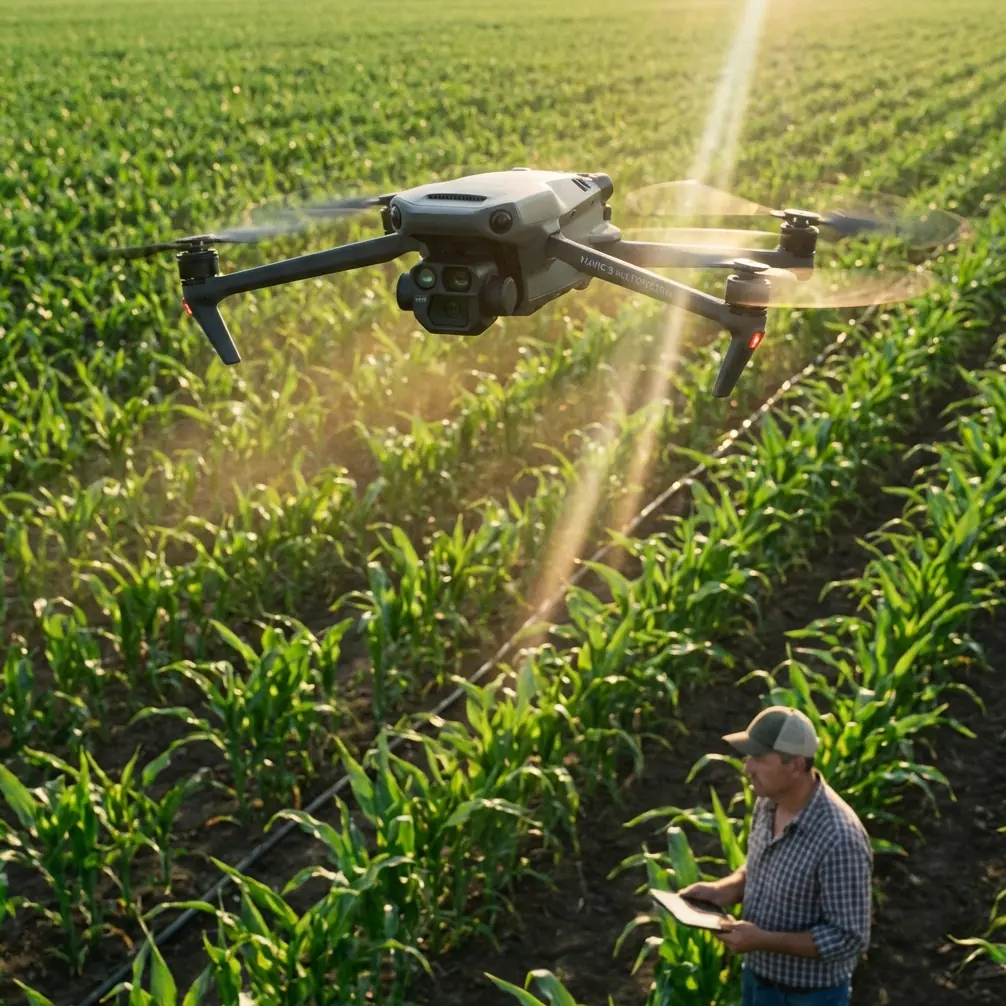
Mavic 3M in Mountain Spray Work: The Flight Altitude Detail That Changes Everything
META: Practical Mavic 3M guidance for mountain spraying environments, including flight altitude strategy, RTK precision, drift control, multispectral scouting, and terrain-aware planning.
Mountain spray work punishes lazy planning.
Flat-field habits break fast once the route starts climbing, dropping, and folding into ridgelines. A spray mission that looks clean on the screen can turn uneven in the air: too high over one terrace, too low near the next, drifting off target when valley wind curls upward in the afternoon. If you are using the Mavic 3M around mountain venues, the most useful question is not “How fast can I cover the area?” It is simpler and more demanding: what altitude should I actually fly to keep application consistent?
That is the operational hinge.
The Mavic 3M is not a heavy spray platform, and that matters. Its role in mountain work is best understood as the aircraft that tells you where, when, and how to spray with fewer mistakes. In steep terrain, that intelligence layer is often more valuable than brute output. A multispectral drone with centimeter-level positioning can keep a mountain operation from wasting chemical, missing stressed sections, or pushing crews into poor-access zones without a plan.
Why mountain spraying is really an altitude-control problem
On level ground, setting a working height is straightforward. In mountains, “3 meters above canopy” is only meaningful if the aircraft can actually hold that relationship while crossing uneven contours.
That is where the Mavic 3M earns its place. With RTK-based positioning aimed at centimeter precision, it gives operators a cleaner spatial reference for mapping irregular terrain and identifying where spray operations will struggle before the tank is ever filled. A strong RTK fix rate is not just a nice spec-sheet phrase. In mountain venues, it determines whether your map-derived routes stay trustworthy at field edges, broken terraces, and narrow strips tucked against slope transitions.
The practical effect is big. If your terrain model is wrong, your sprayer’s real height above crop changes every few seconds. That alters droplet behavior, swath width, and drift potential all at once.
Too high, and the pattern opens up, droplets travel longer, and cross-slope wind has more time to move them. Too low, and coverage becomes patchy or physically risky around trees, poles, wires, and abrupt terrain shoulders.
The altitude insight most crews learn the hard way is this: in mountain venues, there is rarely one “perfect” flight altitude for the whole site. There is only an altitude band that matches canopy height, wind behavior, and the sprayer’s nozzle setup section by section.
The Mavic 3M advantage is not spraying harder. It is scouting smarter.
A lot of drone buyers still make the same mistake photographers once made with portrait lenses: they chase the biggest number instead of the most usable setup.
That camera-world lesson is surprisingly relevant here. In the Canon EF era, many users treated the 85mm f/1.2L II as a kind of holy grail, yet experienced shooters often ended up preferring the EF 85mm f/1.4L IS USM because it was nearly 200 grams lighter and added 4-stop stabilization. On paper, f/1.2 looked more prestigious. In practice, the lighter and stabilized option was often the better working tool. That shift mattered because professionals discovered that the extreme spec was not always the most useful one in real jobs.
Mountain spray operations face the same logic. Bigger payload thinking is seductive, but precision and practicality usually decide results. The Mavic 3M’s multispectral payload, combined with RTK workflow, helps crews identify stress patterns, drainage effects, and inconsistent growth without forcing people to repeatedly walk steep ground. In rough terrain, that is not a luxury. It is labor reduction, safer planning, and better timing.
Instead of blanket spraying every section at the same rate, the Mavic 3M lets you sort the venue into zones. Exposed ridges. Damp lower pockets. Shadow-heavy slopes. Areas with weaker vigor. Areas where crop density will likely intercept droplets differently. Once those zones are visible, altitude and route planning stop being guesswork.
The optimal flight altitude insight for mountain venues
If you want one operating principle to carry into the field, use this:
Set altitude from target interaction, not from map convenience.
For mountain spraying support work with Mavic 3M data, the right altitude is the one that preserves a stable relationship between the spray release point and the canopy across changing terrain. That usually means planning for terrain-following behavior and validating the route against the tallest and most exposed sections, not the average slope.
In practical terms:
- On exposed upper slopes, fly lower within the safe operating envelope to reduce spray drift.
- On broken terraces, prioritize height consistency above canopy rather than a fixed absolute elevation.
- In transition zones where terrain falls away sharply, assume swath width will become less predictable unless the route has been terrain-adjusted.
- Near field edges and ravines, expect updrafts and lateral wind shifts to act differently from what you measured in the loading area.
The Mavic 3M helps because multispectral data reveals where canopy density changes. That matters operationally. Dense, healthy sections can intercept spray differently from sparse, stressed sections. If your flight altitude is too high over sparse canopy, more droplets pass through or drift beyond the target. If it is too low over uneven dense growth, you can create turbulence or uneven overlap. Good mapping turns altitude from a generic safety setting into a treatment variable.
Multispectral data is especially useful in steep terrain
In mountains, visual inspection lies more often than people admit.
A slope can look uniformly green from the road and still contain serious variability driven by drainage, shallow soil, rock exposure, runoff channels, and shade duration. Multispectral mapping helps separate “green enough” from agronomically consistent. For Mavic 3M operators, this is where the aircraft becomes operationally significant rather than simply interesting.
A stressed band running diagonally across a slope may tell you irrigation is not distributing evenly. A weak section near a rocky shoulder may indicate lower vigor and a smaller effective canopy. A damp depression might hold denser biomass and a different disease risk. These are not just agronomy notes. They affect how a spray aircraft should pass, how wide a swath should be trusted, and whether a standard volume is appropriate.
This is one reason mountain venues benefit from pre-spray mapping more than many flat farms do. Uneven terrain magnifies small planning errors.
Drift control starts before the spray drone launches
Spray drift in mountains is often blamed on weather alone. That is too simplistic.
Yes, wind matters. But route direction, relative height above canopy, nozzle calibration, and terrain exposure are often the real amplifiers. The Mavic 3M’s contribution is that it helps you see where those amplifiers exist.
Here is the sequence I recommend:
- Map the venue with RTK enabled and confirm fix quality before committing to the mission.
- Build a terrain-aware surface, not just a boundary outline.
- Use multispectral and RGB review to classify high-risk sections:
- exposed ridges
- narrow contour strips
- terraces with abrupt drops
- areas near tree lines or power infrastructure
- Adjust spray mission design based on those zones:
- tighter altitude control
- conservative swath width
- slower speed where overlap consistency matters most
- Verify nozzle calibration on the actual spray platform against the target canopy condition, not against a flat-land default.
Nozzle calibration deserves more attention than it gets. A perfect map cannot rescue a poor droplet profile. In mountain work, wrong droplet size plus excess altitude is how drift starts looking “mysterious.”
Why inaccessible terrain is exactly where Mavic 3M data pays off
One of the overlooked themes in UAV field practice is that drones are most valuable where sending people is slow, risky, or disruptive.
That principle shows up clearly in powerline inspection. Reference material from DJI education content describes how transmission lines and towers span wide areas and difficult heights, making manual inspection hard and dangerous. It also notes that foreign objects on high-voltage lines can threaten supply safety, while traditional removal may require workers to climb towers, work slowly, and sometimes interrupt power. The larger point is not about copying that exact task. It is about understanding where aerial access changes the economics and safety profile of the job.
Mountain spray venues share that same logic. Steep access roads, unstable footing, fragmented plots, and long walking distances make manual scouting inefficient. If a team has to physically inspect every suspect zone before every application, response time collapses. The Mavic 3M reduces those blind climbs. It can survey upper sections, narrow benches, and hard-to-reach corners quickly, so the spray plan reflects the field you actually have that day.
The same source also mentions wildlife monitoring, where UAVs can enter sensitive activity zones and collect camera evidence while reducing direct human confrontation or disturbance. Again, the transferable lesson is operational distance. In civilian land management, drones create stand-off visibility. For mountain agriculture, that means fewer unnecessary entries into difficult terrain and less time spent making decisions from partial ground observations.
Watch the obstacles nobody wants to talk about
Mountain venues often come with infrastructure.
Poles, guy wires, service roads, tree shelterbelts, pumps, and sometimes nearby transmission corridors. Even if your Mavic 3M mission is only for mapping and prescription support, those features need to be part of the planning model because they affect both airflow and route logic.
A steep valley edge beside utility structures can generate turbulence that makes a planned pass less reliable than it appeared on the tablet. That does not mean the mission is impossible. It means the route should be broken into smaller, more controllable sections.
This is also where old multirotor history still matters. The revival period of multirotor development around 2010 to 2013, with open-source projects such as ArduCopter, OpenPilot, Pixhawk, and later broader platforms like Dronecode, pushed the industry toward modular autonomy thinking rather than pure manual piloting. Today’s operators benefit from that legacy every time terrain-aware planning, waypoint logic, and data workflows save them from improvising mid-mission. The Mavic 3M sits in a more polished ecosystem, but the operational value comes from the same foundation: better mission logic beats heroic stick work.
A practical altitude framework for Mavic 3M-supported spraying
If you are using Mavic 3M to support spraying in mountain venues, I suggest this field framework:
1) Start with a reconnaissance altitude, not a treatment assumption
Map high enough to capture clean terrain context, then refine from the data. Don’t lock your spray altitude before you understand canopy variability.
2) Divide the venue into terrain behavior zones
Do not treat one mountain block as one field. Break it into ridges, midslope bands, shaded pockets, terraces, and edge sections.
3) Use the tallest effective canopy as a safety reference
Average canopy height is often misleading in mountain crops. One taller row near a slope break can be the point that causes poor clearance or unstable overlap.
4) Reduce altitude where drift risk is structurally higher
That often means exposed sections, not just windy moments.
5) Recheck RTK status before critical mapping passes
Centimeter precision is only useful when it is actually present. A weak fix in mountain geometry can quietly degrade the trustworthiness of your terrain model.
6) Match swath width to terrain reality
A wide swath that works on level ground may overpromise in broken topography. Conservative overlap usually wins.
7) Treat nozzle calibration as part of terrain planning
Spray physics and route geometry are connected. They should never be planned separately.
Final thought: the best altitude is the one that stays true to the crop
For mountain spray work, the Mavic 3M is most valuable when it stops the operation from pretending the terrain is simpler than it is.
Its multispectral view helps identify where crop condition changes. RTK support improves the spatial trust behind your maps. Together, those tools help you choose a flight altitude strategy that stays faithful to real canopy position rather than screen-level averages. That is what reduces drift, protects coverage quality, and keeps crews from wasting time on avoidable corrections.
If you want to compare route ideas for a mountain venue or sanity-check an altitude plan, you can send the field layout here: message Marcus directly on WhatsApp.
Ready for your own Mavic 3M? Contact our team for expert consultation.