
Using Mavic 3M for Urban Forest Spraying Planning
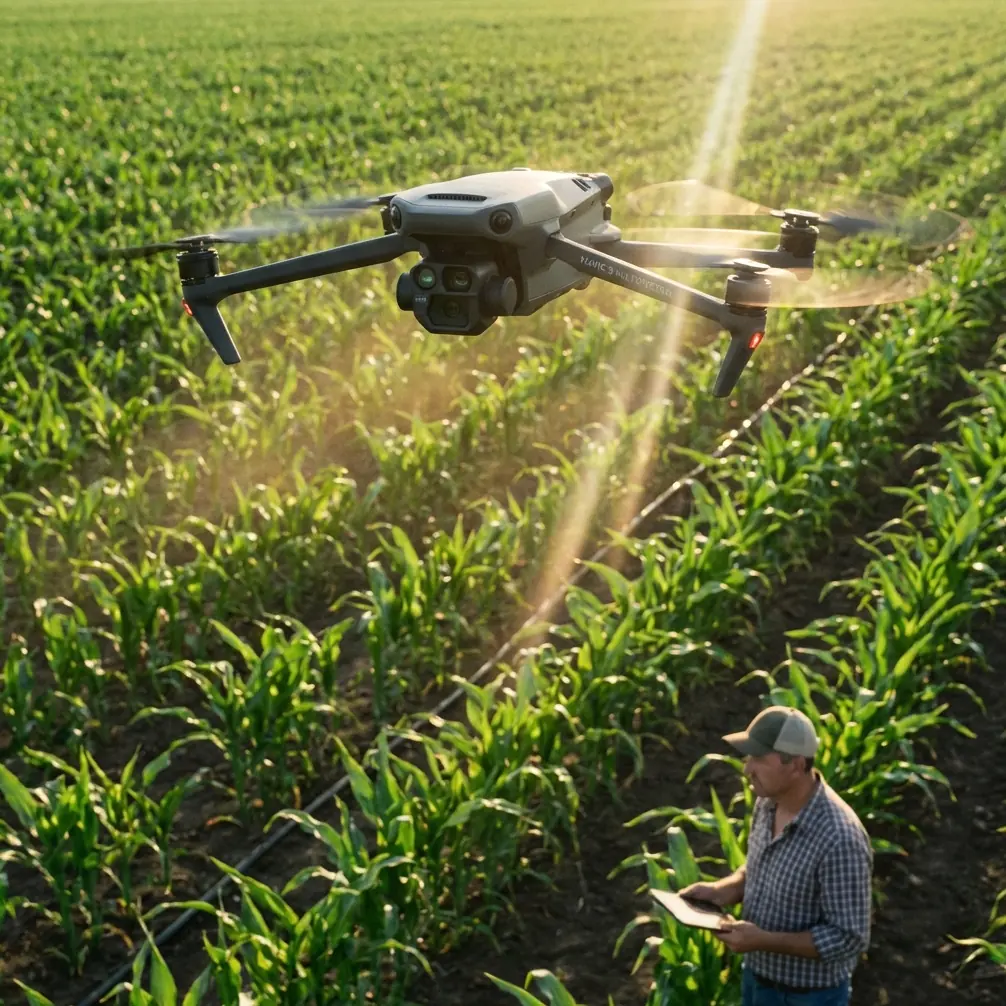
Using Mavic 3M for Urban Forest Spraying Planning: A Case Study in Precision, Interference, and Practical Field Control
META: A field-based case study on using Mavic 3M around urban forests, covering multispectral scouting, RTK reliability, spray drift planning, nozzle calibration logic, and antenna adjustment under electromagnetic interference.
Urban forest spraying is rarely a simple “fly and apply” job. Trees sit next to roads, buildings, parked vehicles, utility lines, footpaths, and public green spaces. That means every decision gets tighter: where the drift can go, how cleanly a route can be repeated, and whether your positioning system stays stable when the aircraft moves between open canopy gaps and signal-cluttered city edges.
This is where the Mavic 3M becomes interesting.
Not because it is a sprayer—it is not—but because it can become the intelligence layer that makes spraying in urban woodland more controlled. In practice, the aircraft’s value is upstream of liquid application: identifying canopy variability, documenting edge risk, checking access, validating swath assumptions, and improving the reliability of a spray plan before the first tank is filled. For crews working around sensitive urban vegetation, that planning phase can save more trouble than raw flight time ever will.
I want to frame this through a real operational lens: a compact urban forest block bordered by low-rise residential buildings on one side and a municipal road on the other. The spray objective was selective treatment planning for stressed tree clusters and invasive pressure zones, not blanket application. The mission challenge was not just vegetation. It was electromagnetic noise from surrounding infrastructure, narrow safety margins, and the need for repeatable geospatial accuracy.
Why Mavic 3M fits the front end of spraying work
The Mavic 3M’s strength in this scenario is its sensing stack. Urban forestry teams often need more than visual imagery because healthy-looking canopy from above can still conceal early stress patterns. Multispectral capture helps separate those weak signals from normal visual texture. That matters when the goal is targeted treatment rather than broad chemical coverage.
In an urban forest, every square meter you avoid spraying unnecessarily reduces off-target exposure risk. So multispectral is not just a mapping feature. It changes the economics and safety profile of the operation by shrinking the treatment footprint to what actually needs attention.
That is especially useful when planning swath width and nozzle strategy for the spray aircraft that follows later. If the scouting data shows that only interior clusters require treatment while perimeter trees remain stable, operators can tighten route geometry and build buffer zones around sidewalks, fences, and residential edges. In other words, the Mavic 3M helps define where not to spray, which is often the more valuable decision.
The hidden problem in urban forests: signal quality, not canopy alone
Many teams expect the biggest technical obstacle to be tree density. In this case, it was electromagnetic interference.
The site had Wi-Fi-heavy residential blocks, roadside electronics, steel fencing, and overhead infrastructure. None of that automatically ends a mission, but together they can degrade confidence in GNSS stability and affect the RTK fix rate if the setup is sloppy. For urban-edge work, centimeter precision only matters if it is consistently maintained across the mission, not just achieved briefly during takeoff.
This is where antenna handling becomes operationally significant. Crews often talk about RTK like it is a software checkbox. It is not. The fix quality depends on environmental conditions and disciplined field setup. In our case, the most useful correction was surprisingly basic: adjusting controller and base antenna orientation to reduce local shielding and improve line-of-sight exposure during the most cluttered legs of the survey.
That sounds minor until you see what happens when it is ignored. Route overlap starts to become less trustworthy near canopy edges, repeat passes drift just enough to complicate change detection, and treatment polygons no longer inspire confidence for downstream spraying. Around urban forestry assets, “close enough” is not good enough.
A high RTK fix rate is not merely a technical brag point. It determines whether your boundary lines, stress maps, and exclusion zones can be trusted when the spray platform enters the site later. If your treatment edge sits beside a public footpath or drainage strip, a few decimeters of uncertainty can have real consequences.
A lesson from outside the drone world: most users misuse good tools
One of the more revealing reference materials behind this discussion was not about aircraft at all. It was a smartphone photography piece arguing that many users misunderstand portrait mode, producing distorted subjects, artificial blur, and a plastic-looking image. The article broke the problem into three factors: settings, lighting, and composition, then highlighted three major mistakes people commonly make.
That framework maps neatly onto Mavic 3M operations in urban forestry.
A surprising number of weak drone datasets come from the same type of operator error. Not hardware failure—misuse. In this case, the equivalents are mission settings, environmental conditions, and flight geometry.
- Settings become altitude, overlap, speed, exposure behavior, RTK configuration, and timing.
- Lighting becomes solar angle, shadow contamination, and reflective interference from nearby surfaces.
- Composition becomes the actual layout of the mapping mission: how flight lines intersect the canopy, edges, roads, and exclusion zones.
Just as portrait mode can create unnatural blur if used carelessly, multispectral and mapping workflows can generate misleading vegetation outputs when flown at the wrong time of day or with poor edge planning. Data may look polished while still being operationally weak. That is a dangerous kind of error because it gives false confidence.
The smartphone reference matters here because it highlights a universal field truth: advanced automation does not protect users from bad assumptions. Whether the tool is a phone camera or a surveying drone, quality still depends on disciplined setup.
Field workflow: from scouting to spray prescription
For this urban forest block, the workflow followed five stages.
1. Define treatment logic before launch
The team first identified what decisions the imagery needed to support. That seems obvious, but many crews still fly first and think later. We needed to separate likely treatment zones from observation-only zones, identify drift-sensitive boundaries, and verify access corridors for the spray platform.
Without that decision framework, even high-resolution imagery can become little more than archive material.
2. Fly multispectral survey with conservative route design
Because the site was electromagnetically messy, route planning favored stable geometry over maximum efficiency. Flight lines were designed to preserve clean overlap around border areas and maintain consistent passes over canopy gaps. Extra caution was applied near buildings and reflective surfaces.
Centimeter precision was the target, but the real metric was consistency. Stable georeferencing across the whole site matters more than isolated precision claims.
3. Monitor RTK behavior and adjust antenna orientation in real time
This was the turning point.
During early passes near the residential edge, fix stability was less consistent than desired. Rather than pushing through, the team paused and repositioned to improve antenna exposure relative to the local clutter. That simple adjustment improved confidence in RTK behavior and reduced concern about edge distortion in the mapping outputs.
The operational significance is straightforward: if you handle interference early, you avoid rebuilding treatment polygons later.
If your team is troubleshooting similar field behavior, sharing a site sketch and signal environment with a specialist can save a wasted mission; one practical option is to message a Mavic 3M workflow specialist before redeploying.
4. Translate plant variability into application zones
Once the data was processed, the multispectral outputs helped separate uniform canopy from stress-concentrated sections. The next step was not to create a blanket spray map. It was to carve out zones where treatment intensity, swath direction, and drift controls could be tailored.
This is where swath width becomes more than a machine specification. In urban forests, swath width is a boundary-management tool. A wide pass may be efficient in open land, but near mixed canopy and public edges it can increase overshoot risk or force awkward route compromises. Scouting data from the Mavic 3M helps crews decide where narrower, more controlled application lanes are worth the extra time.
5. Build nozzle calibration around canopy reality
Nozzle calibration is often treated as a maintenance task. In urban forestry, it should be treated as a planning decision tied directly to vegetation structure. The scouting mission showed that not all canopy sections had the same density or target depth. That meant the spray aircraft should not rely on a one-size-fits-all droplet and flow assumption.
This is where the Mavic 3M indirectly improves spray quality. By revealing canopy variability before application, it allows calibration choices to reflect the actual target environment. That reduces over-application in sparse zones and under-coverage in denser pockets.
Spray drift is the real urban constraint
If there is one issue that dominates urban forest spraying, it is drift.
Buildings channel airflow. Roadside heat changes local movement. Tree rows create turbulence. Open gaps produce uneven deposition patterns. In that environment, even a well-calibrated spray aircraft can produce poor results if the treatment map is too blunt.
The Mavic 3M helps by making drift planning spatially specific. You can identify perimeter trees, public-facing edges, open hardscape, and sheltered interior zones separately instead of treating the forest block as one homogeneous area. That allows for route direction choices that reduce downwind exposure and supports more defensible no-spray buffers.
An urban spray plan built from poor reconnaissance tends to lean on operator instinct. An urban spray plan built from current multispectral and mapped canopy data is far easier to justify and refine.
What IPX6K means in the real world
The IPX6K mention in your operating context deserves practical interpretation. For crews working around vegetation, dust, residue, and wet field conditions, environmental resistance matters because these missions are rarely clean. Moisture, splash, and debris are not edge cases. They are normal.
That does not remove the need for careful handling, but it does support routine field deployment in less-than-ideal conditions. In urban forest work, where crews may transition from damp canopy edges to open roadside staging areas, durability is a workflow factor, not just a specification sheet line.
A useful training parallel from educational and fixed-wing references
Two other reference documents offered a subtle but valuable lesson.
The DJI TT education material described a simple countdown logic using a variable set to 10, then reduced by 1 second intervals until reset. On the surface, that has nothing to do with Mavic 3M forestry work. But operationally, it reflects a mindset that drone teams often neglect: sequence control. A successful field mission depends on structured triggers, checks, and resets. RTK confirmation, sensor checks, interference review, boundary verification, and post-flight validation should happen as a deliberate chain, not as casual habits.
The model aircraft training reference adds a second lesson. It notes that turns should be controlled carefully, with bank angle kept below 30 degrees, and that training flights should emphasize repeatable route discipline rather than improvisation. Again, the direct platform is different, but the principle transfers cleanly. In urban-edge mapping, disciplined route geometry beats aggressive maneuvering every time. Stable lines create trustworthy datasets. Sharp corrections and rushed edge handling do not.
These details matter because Mavic 3M performance in a spray-planning role is only as good as the crew’s procedural discipline. Good operators do not just collect data. They build repeatability into the mission.
What this means for urban forestry teams
If you are evaluating the Mavic 3M specifically for “spraying forests,” the best way to think about it is not as the aircraft that applies the liquid. Think of it as the aircraft that prevents avoidable spraying mistakes.
Its value shows up when you need to:
- isolate treatment zones using multispectral evidence rather than visual guesswork
- maintain high-confidence geospatial consistency with strong RTK behavior
- manage electromagnetic interference through smarter antenna setup and field positioning
- refine swath width decisions for constrained urban edges
- support nozzle calibration choices with actual canopy structure
- reduce spray drift exposure by designing better exclusion and buffer zones
That combination is what makes it useful in urban forest operations. Not spectacle. Not theory. Control.
And control is what these sites demand. When trees are woven into public infrastructure and residential surroundings, every preventable error becomes expensive. A well-flown Mavic 3M mission narrows uncertainty before the sprayer arrives. That is its real contribution.
Ready for your own Mavic 3M? Contact our team for expert consultation.