
Mavic 3M for Mountain Spraying: What Actually Matters
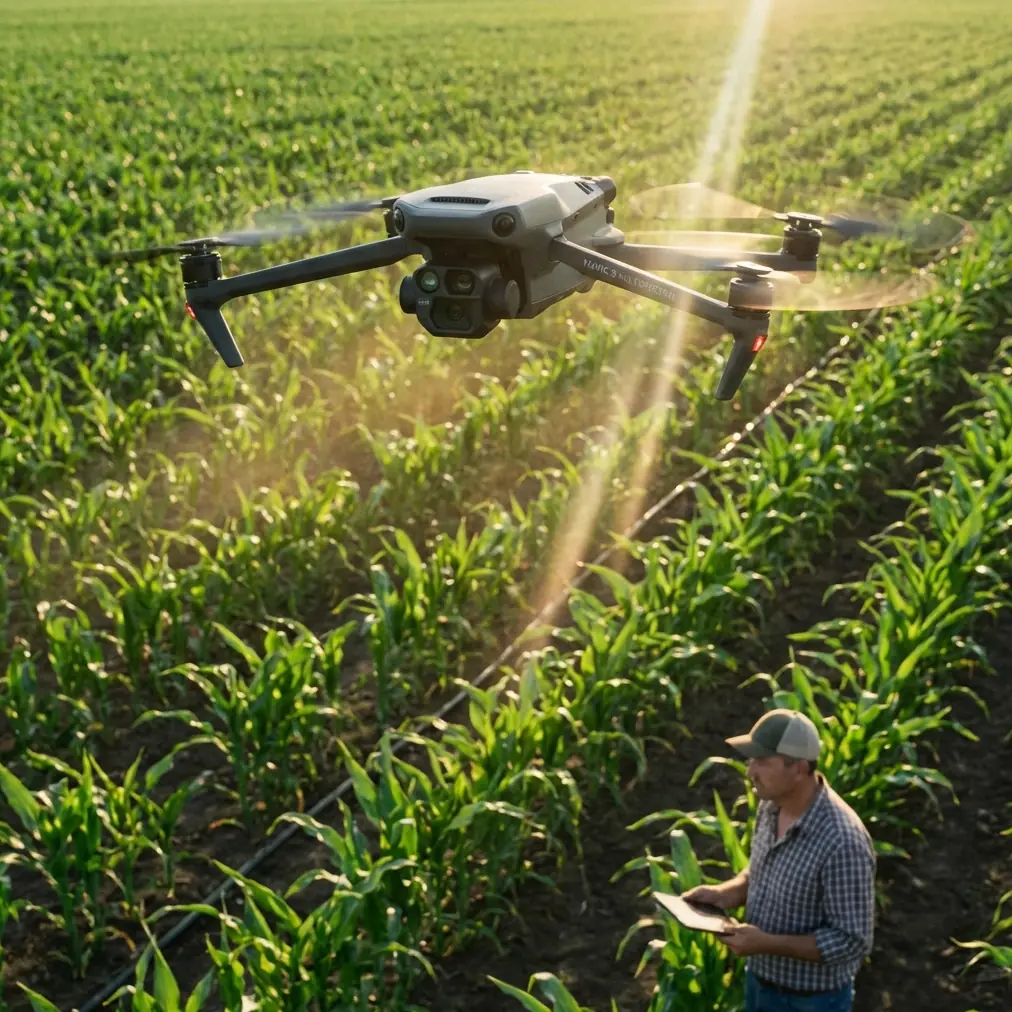
Mavic 3M for Mountain Spraying: What Actually Matters in the Field
META: A technical review of using the Mavic 3M to support mountain spraying workflows, with practical insight on multispectral scouting, RTK precision, spray drift reduction, swath planning, and battery management.
By Marcus Rodriguez, Consultant
People often ask whether the Mavic 3M is a spraying drone for steep, fragmented farmland. The short answer is no. It does not replace a dedicated application platform with a tank, pump, and nozzle set. But that framing misses the real value. In mountain agriculture, the Mavic 3M can become the aircraft that makes spraying more precise, less wasteful, and safer to execute on difficult terrain.
That distinction matters because mountain fields punish sloppy assumptions. Slopes distort your sense of spacing. Wind behaves differently near ridgelines and terraces. Access roads are narrow or absent. Water refill points may be far from the work zone. Every unnecessary pass costs time, battery cycles, and often chemical performance. A drone that helps the operator decide where to spray, how wide to fly, and when to stop has an outsized effect on the final result.
The Mavic 3M fits that role unusually well because it combines compact deployment with multispectral data capture and RTK-ready positioning. In flat fields, those features are useful. In mountain blocks, they become operationally meaningful.
Why the Mavic 3M matters before the first drop is sprayed
If your reader scenario is spraying fields in the mountains, the biggest mistake is starting with the spray aircraft. Start with field intelligence.
The Mavic 3M’s multispectral capability is the reason. In uneven terrain, crop stress is rarely uniform across an entire parcel. One terrace may hold moisture longer. The upper edge of a slope may show weaker vigor because of runoff and shallow soil. Shade bands, drainage lines, and broken canopy zones all change how a treatment should be planned. A visual check from the ground will catch the obvious problems. It usually misses the pattern.
Multispectral flights help you identify those patterns before you load liquid into anything. That changes the spraying plan in at least three practical ways.
First, you can prioritize treatment zones instead of blanketing the whole mountain block. That reduces unnecessary passes and helps limit spray drift exposure in areas where application is not needed.
Second, you can adjust your expected swath width based on real canopy variation rather than using one assumption for the whole site. Mountain fields rarely give you that luxury. If canopy density opens up on the windward side, drift potential changes. If the lower terrace has denser leaf mass, penetration expectations change too.
Third, you can improve staging. On steep sites, where battery changes and refill logistics eat a large part of the day, knowing the exact high-priority sections lets crews place batteries, support personnel, and refill materials closer to the work that matters.
That is where the Mavic 3M earns its keep. Not by spraying itself, but by letting the operator spray with intent.
RTK precision is not just about maps
A lot of buyers see RTK and think of nicer orthomosaics. That is only part of the story.
For mountain spraying support, centimeter precision helps because terrain compresses your margins. A terrace edge, a drainage ditch, a stone wall, or a greenhouse boundary may sit only a few meters from the target crop. In those conditions, RTK Fix rate is not a specification to admire on a sheet. It is a confidence factor.
A stable fix means cleaner field boundaries, more reliable repeatability between scouting and treatment flights, and less ambiguity when you hand off data to the spraying team. If the Mavic 3M marks a stressed band along a slope shoulder, the application crew needs to trust that the marked strip is where the problem actually is. Without reliable positional consistency, variable treatment planning becomes guesswork.
On steep ground, this also supports safer route design. A precise terrain-aware map can reduce awkward transitions and help operators avoid sending a spray platform into inefficient, battery-hungry climbs just to cover areas that did not need treatment in the first place.
That kind of planning discipline becomes even more valuable when weather windows are narrow. In mountain environments, calm morning periods can disappear quickly. If the scouting data and treatment layout line up accurately, the crew can move faster when conditions are usable.
Spray drift starts long before the spray flight
Spray drift is one of the biggest concerns in mountain agriculture because air movement is rarely consistent. You can have an apparently calm launch point and still find crossflow or uplift twenty meters away on the face of the slope.
The Mavic 3M helps here in an indirect but critical way. By identifying only the zones that need intervention, it cuts down the number of passes required. Fewer passes mean fewer opportunities to lose product to drift. That sounds simple, but on broken terrain, pass reduction is often the easiest and most effective drift control measure available.
It also gives the operator a better basis for nozzle calibration decisions on the dedicated sprayer. Calibration should never be static across every mountain site. Droplet behavior, target density, travel speed, and elevation changes all interact. If the Mavic 3M survey shows sparse stress confined to upper terraces, the treatment plan may favor tighter targeting and more conservative coverage instead of a broad, uniform approach.
That is how scouting turns into application quality. Not through theory, but through restraint. Spray only where the field justifies it. Match setup to the actual crop condition. Avoid pretending the mountain is flat.
The swath width problem nobody mentions enough
In flat open fields, operators can settle into a rhythm with consistent spacing. Mountain plots resist that. Row orientation changes. Tree lines interrupt airflow. Terraces create step-like microenvironments. Swath width that behaves predictably in one section can become unreliable in the next.
This is another reason the Mavic 3M belongs in the workflow. Its mapping pass lets you see where regular spacing will break down before you commit a treatment aircraft to the job. You can segment blocks intelligently, use narrower operational assumptions where turbulence risk is higher, and avoid forcing one uniform pattern over highly irregular ground.
That does not just improve coverage. It protects battery efficiency.
A poorly planned mountain mission burns energy in acceleration, climbing corrections, and repeated overlap. Better segmentation reduces wasted motion. And wasted motion in the mountains is expensive in a way flatland operators sometimes underestimate.
A field battery tip that saves more time than people expect
Here is one lesson from actual field work: in mountain spraying support, do not drain your Mavic 3M batteries as if every percentage point is free.
On steep sites, launch and recovery are rarely ideal. You may be taking off from a narrow terrace, a dirt shoulder, or a temporary staging point with uneven footing. Wind can change on approach. If you use batteries too aggressively during mapping, you leave yourself less margin for safe recovery and less flexibility if you need one extra pass to close a gap.
My rule in mountain operations is simple: rotate batteries earlier than you think you need to, especially on cool mornings that turn warm fast. Battery behavior can feel excellent in the first flights of the day and then become less predictable as turnaround speed increases and the work tempo gets messy. Keep one pack mentally reserved for solving problems, not just finishing plans.
The hidden benefit is workflow stability. Crews who push packs to the edge save a few minutes and then lose twenty when they have to reposition, wait, cool batteries, or redo incomplete coverage. Crews who manage batteries conservatively tend to finish cleaner.
If you are building a mountain spraying workflow around the Mavic 3M, treat battery logistics as part of mapping accuracy. A rushed final pass with a low pack often creates the exact data gaps that later complicate the spray mission.
IPX6K-style resilience matters more in dirty agricultural environments
Agricultural fieldwork is hard on aircraft, especially around spraying operations. Fine mist, mud, fertilizer dust, and sudden weather shifts are normal. While the Mavic 3M is not a heavy spray platform, environmental resilience is still a real concern in mountain use because staging areas are often improvised and far from clean support facilities.
That is why users pay attention to protection ratings and overall durability expectations. In practice, the issue is not surviving dramatic conditions. It is surviving repeated ordinary abuse: damp grass at dawn, dusty vehicle transport, residue in the air, and quick redeployments from one terrace to another.
A compact aircraft with strong field practicality can be moved quickly and launched from places where larger systems become cumbersome. That deployment speed is one of the underappreciated reasons the Mavic 3M works so well in support of mountain spraying operations. You can scout a block, assess wind-exposed edges, update treatment priorities, and move on without dragging a complex footprint behind you.
A surprising lesson from an unrelated planning system
There is an interesting parallel in the way Dongguan’s 2026 high school self-enrollment plan is structured. The city requires candidates to register through a centralized online system between April 17 and 20, and each student may apply to only one school and one project. Different field, completely different stakes, but the planning logic is familiar: define a narrow submission window, standardize the process, and force a single committed choice instead of chaotic overlap.
That same discipline is exactly what mountain spraying operations need.
If you try to scout every block, spray every block, and improvise priorities in real time, the day falls apart. The better approach is closer to that one-school, one-project rule: one flight objective, one treatment priority, one decision at a time. Use the Mavic 3M to identify the highest-value intervention, then structure the spray mission around that, rather than letting the whole mountain demand attention at once.
The registration deadline detail matters too. A fixed window sharpens behavior. In the field, your fixed window is usually weather. Early calm air may only give you a few good hours. If your maps, RTK setup, battery rotation, and spray coordination are not ready beforehand, you miss the window and spend the day chasing conditions that never stabilize.
So while the education notice itself has nothing to do with drones, two details stand out operationally: the April 17 to 20 submission period reflects how narrow execution windows drive disciplined preparation, and the one-school-one-project limit mirrors the value of committing to a single, clearly defined mission objective. Mountain spraying gets better when crews think that way.
What a strong Mavic 3M mountain workflow looks like
A useful workflow is not complicated.
Scout first with the Mavic 3M and use multispectral results to isolate stress zones. Confirm that your RTK positioning is stable enough to support confident handoff to the treatment team. Review the slope sections where swath assumptions are likely to collapse. Then build a spray plan that respects local wind behavior, terrace geometry, and refill logistics.
After that, calibrate nozzles on the spraying platform for the actual task, not a generic farm average. If target density or exposure differs across elevations, acknowledge it. Do not force one setup everywhere simply because it is easier.
Most of all, resist the urge to confuse aircraft capability with workflow capability. The Mavic 3M is powerful because it sharpens decisions. On mountain ground, sharper decisions usually matter more than bigger payloads.
Where the Mavic 3M delivers its best value
The Mavic 3M is at its best when the field is too complex for blanket treatment and too valuable for guesswork. That describes a lot of mountain agriculture.
Its multispectral intelligence helps you separate urgent areas from background noise. RTK-backed precision improves repeatability between scouting and treatment. Compact deployment reduces the drag that steep terrain puts on operations. And when handled with disciplined battery management and realistic swath planning, it becomes one of the most practical support tools available for mountain spraying teams.
If you are trying to build a more reliable workflow around difficult terrain, this is the right place to start. And if you want to compare field setups or talk through a mountain spraying scenario in detail, you can message us here.
Ready for your own Mavic 3M? Contact our team for expert consultation.