
Precision Field Scouting with the DJI Mavic 3M
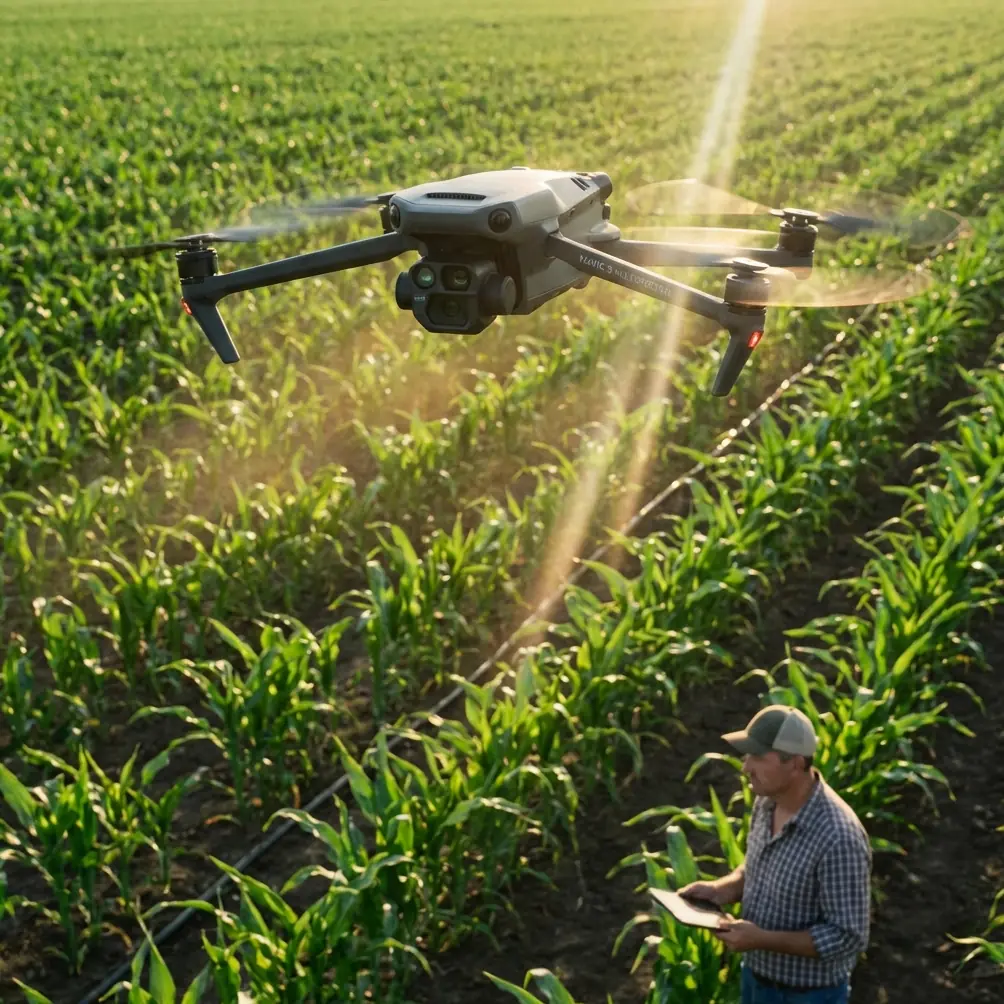
Precision Field Scouting with the DJI Mavic 3M
META: Discover how the DJI Mavic 3M multispectral drone transforms low-light field scouting with centimeter precision, RTK fix rate accuracy, and advanced imaging.
TL;DR
- The Mavic 3M combines an RGB camera with four multispectral sensors, making it uniquely capable for agricultural field scouting in challenging low-light conditions
- RTK fix rate accuracy delivers centimeter precision positioning, enabling repeatable flight paths across entire growing seasons
- A critical pre-flight cleaning step on the multispectral lens array directly impacts data quality and can prevent costly misdiagnoses of crop stress
- Compact form factor and IPX6K-rated weather resistance let you scout fields at dawn and dusk when conditions reveal the most about crop health
By Marcus Rodriguez, Agricultural Drone Consultant
Why Low-Light Scouting Changes Everything for Crop Management
Most growers lose actionable data because they scout at the wrong time of day. The DJI Mavic 3M is engineered to capture multispectral imagery during the narrow golden windows—early morning and late evening—when plant stress signatures are most pronounced and solar angle interference is minimized. This technical review breaks down exactly how the Mavic 3M performs in low-light field scouting, what specifications matter, and how to extract maximum value from every flight.
Scouting during low light isn't just a convenience preference. It's a data quality strategy. Midday flights introduce specular reflectance, oversaturated pixels, and inconsistent NDVI readings. The Mavic 3M's sensor architecture was built to handle the spectral complexity that dawn and dusk conditions demand.
The Pre-Flight Cleaning Step You Can't Skip
Here's a lesson that cost one of my clients an entire season of baseline data: contaminated multispectral lenses produce catastrophically inaccurate vegetation indices. Before every flight—and I mean every single flight—you need to clean the four multispectral sensors and the integrated sunlight sensor on top of the aircraft.
Agricultural environments deposit pollen, dust, spray drift residue, and moisture on lens surfaces faster than you'd expect. A single fingerprint on the NIR sensor can reduce transmittance by 12-18%, throwing off your NDVI calculations entirely. The sunlight sensor on top of the airframe is even more vulnerable because most operators forget it exists.
My pre-flight cleaning protocol takes 90 seconds:
- Blow loose debris off all five imaging sensors with a rocket blower (never canned air—propellant residue is worse than dust)
- Wipe each multispectral lens with a fresh microfiber cloth using a single circular motion
- Clean the upward-facing sunlight irradiance sensor with the same cloth
- Inspect the RTK antenna surface for moisture or debris that could degrade fix rate
- Verify that no residue from previous nozzle calibration sessions has migrated to the camera gimbal
This step isn't just about image quality. It's a safety feature. Contaminated sensors can report false NDVI values that lead to incorrect variable-rate application maps. If those maps feed into an autonomous sprayer adjusting swath width and spray drift parameters, you're applying the wrong inputs to the wrong zones.
Expert Insight: I keep a dated log of pre-flight cleaning for every mission. When clients question anomalous data from a specific flight, this log has saved my credibility—and their crop management decisions—more than once.
Multispectral Sensor Architecture: A Technical Breakdown
The Mavic 3M packs four discrete multispectral cameras alongside one RGB camera into a stabilized gimbal assembly. Each multispectral sensor captures a 2MP image at specific wavelength bands critical for vegetation analysis.
Spectral Band Configuration
| Band | Wavelength (nm) | Primary Agricultural Use |
|---|---|---|
| Green (G) | 560 ± 16 | Chlorophyll assessment, visual reference |
| Red (R) | 650 ± 16 | Chlorophyll absorption analysis |
| Red Edge (RE) | 730 ± 16 | Early stress detection, nitrogen status |
| Near-Infrared (NIR) | 860 ± 26 | Biomass estimation, NDVI calculation |
| RGB | 1/2" CMOS, 20MP | Visual scouting, orthomosaic generation |
The red edge band at 730nm is what separates serious agricultural platforms from consumer drones with bolted-on NDVI filters. Red edge sensitivity detects nitrogen deficiency and early disease stress days before symptoms become visible in standard RGB or even basic NIR imagery.
Low-Light Sensor Performance
In pre-dawn and post-sunset scouting conditions, the Mavic 3M's multispectral sensors maintain usable output down to approximately 150 lux ambient illumination. The integrated sunlight irradiance sensor compensates for changing light conditions by recording downwelling radiation simultaneously with each image capture, enabling accurate reflectance calibration even as ambient light shifts rapidly.
The RGB camera uses a 1/2-inch CMOS sensor with an f/2.8 aperture and supports mechanical shutter operation, which eliminates rolling shutter distortion during flight. At low light, the mechanical shutter allows longer exposure times without the geometric warping that electronic shutters introduce—a critical advantage when you need both spectral and spatial accuracy.
RTK Positioning: Why Fix Rate Matters More Than You Think
The Mavic 3M supports RTK (Real-Time Kinematic) positioning via the DJI D-RTK 2 base station or NTRIP network connections. In agricultural scouting, RTK isn't optional—it's the difference between useful time-series data and noise.
Standard GPS accuracy of ±1.5 meters means your flight lines shift between missions. When you're comparing NDVI maps from week three to week seven of the growing season, that positional drift makes pixel-to-pixel comparison meaningless.
RTK delivers centimeter precision—typically ±1-2cm horizontal and ±1.5cm vertical when maintaining a solid fix. The key metric to monitor is RTK fix rate, which represents the percentage of your flight where the system maintains full integer ambiguity resolution.
Factors that degrade RTK fix rate during low-light scouting:
- Wet vegetation canopies increasing multipath interference
- Morning dew on the RTK antenna reducing signal reception
- Longer flight distances from base station during large field surveys
- Atmospheric conditions at dawn and dusk altering ionospheric delay models
- Obstructions on field perimeters (tree lines, structures) blocking satellite visibility
Pro Tip: Target an RTK fix rate above 95% for any mission intended to generate variable-rate prescription maps. If your fix rate drops below 85%, the resulting positional uncertainty exceeds the resolution benefits of multispectral imaging, and you're better off re-flying. Check fix rate in real-time on the DJI Pilot 2 interface—don't wait until post-processing to discover a degraded mission.
Technical Comparison: Mavic 3M vs. Competing Agricultural Platforms
| Specification | DJI Mavic 3M | Platform B (Fixed-Wing MS) | Platform C (Multirotor MS) |
|---|---|---|---|
| Multispectral Bands | 4 + RGB | 5 + RGB | 4 + RGB |
| MS Sensor Resolution | 2MP per band | 1.2MP per band | 3.2MP per band |
| RTK Support | Yes (D-RTK 2 / NTRIP) | Yes (built-in) | Optional module |
| Max Flight Time | 43 minutes | 59 minutes | 28 minutes |
| Weather Rating | IPX6K | IP43 | IP54 |
| Mechanical Shutter | Yes (RGB) | No | Yes (all sensors) |
| Weight (Ready to Fly) | 951g | 3,800g | 2,450g |
| Single-Flight Coverage (at 60m AGL) | ~200 hectares | ~400 hectares | ~80 hectares |
| Sunlight Irradiance Sensor | Integrated | External calibration panel only | Integrated |
| Setup Time | <5 minutes | 15-20 minutes | 8-12 minutes |
The Mavic 3M's IPX6K rating deserves special attention for low-light scouting scenarios. Dawn flights frequently encounter morning dew, fog, and light drizzle. An IPX6K rating means the aircraft withstands high-pressure water jets from any direction, which provides substantial margin over the moisture conditions typical during early-morning agricultural operations.
The 951g total weight also places the Mavic 3M in a regulatory sweet spot in many jurisdictions, simplifying certification requirements and enabling rapid deployment without extensive pre-flight authorization processes.
Optimizing Swath Width and Flight Parameters for Low Light
Getting the flight planning right is where theory meets field reality. Swath width—the ground coverage per pass—is a function of altitude, sensor field of view, and required overlap percentage.
Recommended low-light flight parameters for the Mavic 3M:
- Altitude: 40-60m AGL (lower altitudes compensate for reduced light by increasing ground sampling distance)
- Forward overlap: 80% (increase from the standard 75% to account for potential exposure variation between frames)
- Side overlap: 75% (maintaining consistent lateral coverage for orthomosaic stitching)
- Flight speed: 7-9 m/s (slower than midday flights to allow adequate exposure times)
- Image format: TIFF for multispectral bands (preserving full radiometric resolution), JPEG + DNG for RGB
At 50m AGL, the multispectral sensors achieve a ground sampling distance of approximately 2.5cm/pixel. Combined with centimeter precision RTK positioning, this resolution is sufficient to identify individual plant-level stress patterns across row crops.
Nozzle calibration data from previous spray applications can be overlaid with multispectral maps to correlate application uniformity with crop response. If you're seeing stress patterns that mirror your sprayer's swath width, you've likely identified a nozzle calibration issue rather than a pest or disease problem.
Common Mistakes to Avoid
1. Skipping the radiometric calibration panel. Flying without capturing a calibration panel image before and after each mission makes your reflectance data unreliable. In low light, this is even more critical because the irradiance sensor alone cannot fully compensate for atmospheric scattering.
2. Using identical flight plans for all times of day. Low-light conditions require adjusted speed, overlap, and altitude parameters. Copy-pasting your noon flight plan into a dawn mission guarantees underexposed, unusable multispectral data.
3. Ignoring spray drift residue on sensors. If you operate near active spray operations or store your Mavic 3M near agricultural chemicals, spray drift deposits accumulate on lens surfaces invisibly. Regular isopropyl alcohol cleaning is essential—not just dry wiping.
4. Flying without verifying RTK fix status. Launching before achieving a stable RTK fix and assuming the system will converge in-flight is a gamble. Wait for a solid fix on the ground. The extra 60-90 seconds saves hours of post-processing headaches.
5. Neglecting firmware and calibration updates. DJI periodically updates the Mavic 3M's spectral calibration coefficients and flight controller algorithms. Running outdated firmware can introduce systematic errors into your vegetation index calculations that are impossible to identify in the field.
Frequently Asked Questions
Can the Mavic 3M capture usable multispectral data before sunrise or after sunset?
The multispectral sensors require a minimum ambient light threshold to produce data with acceptable signal-to-noise ratios. In practice, the Mavic 3M captures usable multispectral imagery from approximately 20-30 minutes before sunrise through 20-30 minutes after sunset, depending on cloud cover and atmospheric clarity. The RGB camera with its larger sensor and wider aperture extends this window slightly further for visual scouting. Below the minimum light threshold, sensor noise overwhelms the vegetation reflectance signal, making vegetation index calculations unreliable.
How does the IPX6K rating perform in real-world agricultural conditions?
The IPX6K certification means the Mavic 3M has been tested against high-pressure, high-volume water spray from all directions. In field conditions, this translates to confident operation in heavy dew, fog, light to moderate rain, and irrigation overspray. However, the rating does not cover submersion. Avoid flying through active pivot irrigation streams or landing in standing water. I've operated the Mavic 3M in sustained drizzle for over 30 minutes without any performance degradation, but I always perform a thorough dry-down and lens cleaning immediately after wet-condition flights.
What RTK fix rate should I expect during typical agricultural scouting missions?
With a properly positioned D-RTK 2 base station (elevated, unobstructed sky view, within 5km of the flight area), expect RTK fix rates of 97-99% under good satellite constellation geometry. NTRIP network connections typically yield 92-97% fix rates depending on cellular connectivity and baseline distance to the nearest reference station. Low-light missions at dawn and dusk can experience slightly lower fix rates due to ionospheric activity patterns, particularly during periods of elevated solar activity. Monitor fix rate throughout the mission and flag any segments that drop below 90% for potential re-flight.
Ready for your own Mavic 3M? Contact our team for expert consultation.