
Mavic 3M in Complex Terrain: A Practical Field Monitoring
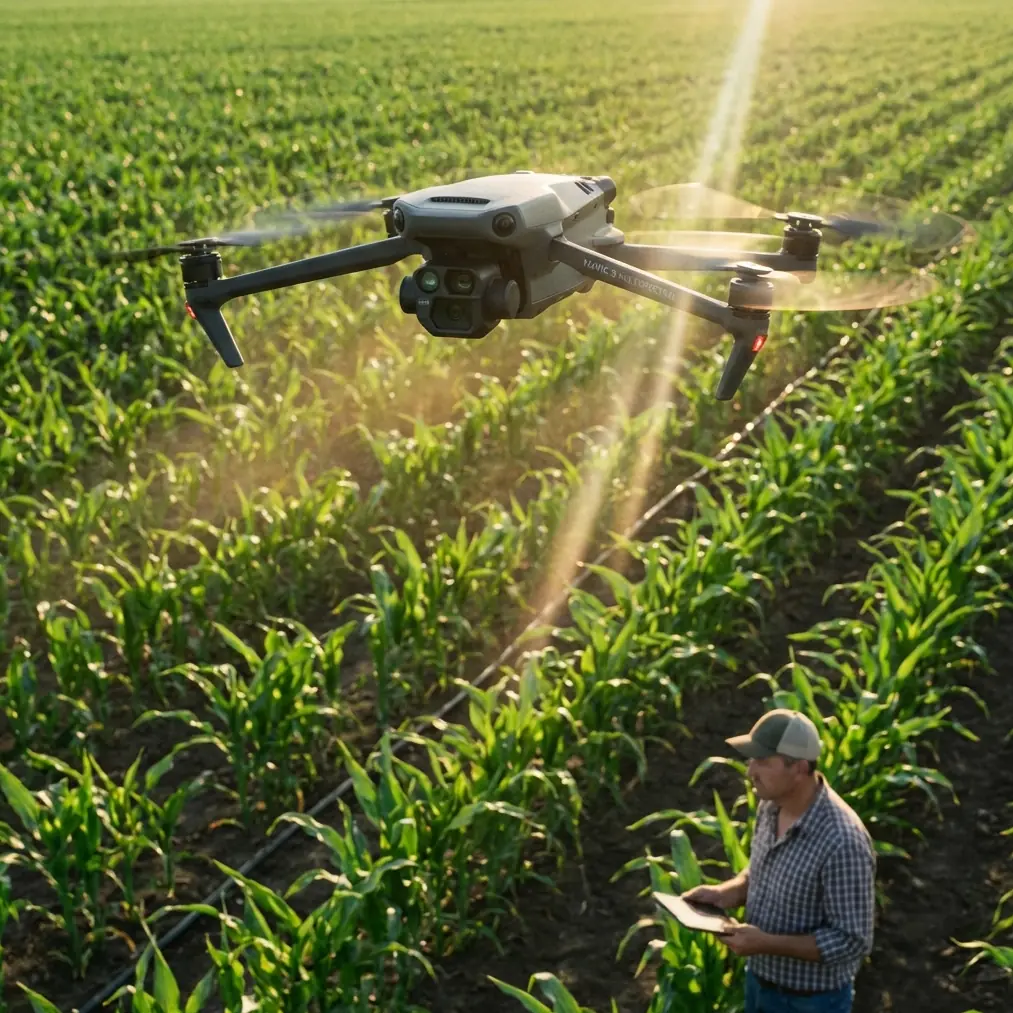
Mavic 3M in Complex Terrain: A Practical Field Monitoring Workflow That Actually Holds Up
META: A field-tested look at using Mavic 3M for monitoring crops in complex terrain, with lessons from UAV forest mapping, RTK positioning, multispectral data handling, and safer pre-flight habits.
Complex terrain exposes every weak link in an agricultural drone workflow.
Flat, uniform fields forgive a lot. Hillsides do not. Terraced blocks do not. Irregular field edges, tree lines, mixed crop vigor, and changing elevation all put pressure on positioning, image consistency, and the quality of the map you hand back to a grower. If you are using the Mavic 3M to monitor fields in this kind of environment, the real challenge is not simply getting airborne. It is producing data that remains trustworthy once you start drawing boundaries, comparing plant health zones, or making decisions about where to scout next.
That is where a smarter workflow matters more than raw aircraft specs.
The most useful lesson from older UAV remote-sensing work is surprisingly simple: the image is only the beginning. In one forest resource survey study, operators created new shapefiles in ArcCatalog using four geometry types—point, line, polygon, and multipoint—then brought both imagery and shapefiles into ArcMap for editing and vectorization to produce a thematic forest zoning map. That may sound old-school compared with today’s cloud platforms, but the operational point is still sharp. A flight only becomes actionable when imagery is turned into boundaries, categories, and measurable areas.
For Mavic 3M users, especially in complex terrain, that means thinking beyond “capture multispectral data” and toward “how will this dataset become a reliable field decision layer?”
Why terrain complexity changes the job
On a simple field, the multispectral story is usually straightforward. You fly, process, inspect vigor differences, and identify suspect zones. In broken terrain, the same process can go sideways for three main reasons.
First, slope and elevation shifts can distort apparent crop patterns if your geometry is sloppy. A patch that looks weak may partly reflect positional drift, variable overlap, or poor terrain compensation.
Second, boundary accuracy becomes more valuable. In complex fields, a few meters of error at the edge of a management zone can push a scout to the wrong bench, the wrong row block, or the wrong drainage pocket.
Third, interpretation gets messier. What looks like a nutrition issue from above may be mixed canopy structure, shadowing from terrain, or a transition between varieties. The forest study makes this point indirectly but clearly: misclassification did not come only from image limitations. Some stands were mixed by nature, and the classification system itself did not fully account for that reality. Agriculture has the same problem. Mixed signals in the canopy are not always sensor failures. Sometimes the field is genuinely heterogeneous.
That is why Mavic 3M operators working in rugged or segmented farmland should treat mission planning, RTK stability, and post-processing discipline as one system.
Start with the safety detail many pilots skip
Before takeoff, clean the aircraft properly—especially the vision sensors, camera surfaces, landing gear contact areas, and any exposed body sections where mud, spray residue, or dust can collect.
This is not housekeeping for its own sake. In agricultural environments, residue buildup can compromise obstacle sensing reliability, affect image clarity, and interfere with the consistency of your mission over multiple flights. If you are operating near irrigation mist, fine dust, or leftover foliar applications, that contamination accumulates faster than many crews expect.
This pre-flight cleaning step also ties directly into the safety features you rely on in uneven terrain. Older DJI platform literature emphasized how much operational value came from high-definition downlink, GPS-based aircraft location display, low-voltage return-to-home, and loss-of-signal return-to-home. Those functions are not just convenience items in rough country. They are what keep a mapping run recoverable when line of sight is interrupted by terrain undulation or when attention is split between topography and crop condition. A clean, inspection-ready aircraft reduces avoidable failure points before you ask the automation stack to do its job.
If your team needs a field checklist tailored to hill farms, orchards, or broken parcel layouts, you can send a quick note here: message our flight workflow desk.
The real value of centimeter precision
The Mavic 3M conversation often gets reduced to “multispectral equals crop map.” That misses the part that matters most in complex terrain: spatial confidence.
The forest survey reference flagged geometric correction as a research hotspot and noted that if UAV attitude data, GPS-recorded capture positions, and supporting information such as terrain data can be combined in real time, geometric accuracy can improve. That observation remains highly relevant to agricultural drone operations today. It is the backbone of why RTK fix rate and terrain-aware mission setup matter so much.
If your Mavic 3M is delivering centimeter-level positioning consistently, the practical benefits stack up fast:
- repeat flights align better across dates
- management zones hold their shape when compared over time
- edge boundaries are easier to trust
- scouting teams spend less time searching for the exact problem patch
- crop stress signatures are less likely to be confused with positional wobble
In complex terrain, a strong RTK fix rate is not a bragging-right metric. It is what separates a map that supports agronomic decisions from one that merely looks clean on a screen.
This also affects how useful your multispectral outputs become in the real world. A vigor anomaly on a steep slope means something very different when you know its position is stable to the row block you intend to inspect. Centimeter precision turns a color pattern into a field task.
What older UAV systems still teach us about field operations
Legacy platform references can be surprisingly useful when evaluating modern workflows. One older DJI example listed an 18-minute maximum flight time, 2.395 kg takeoff weight, a 6000 mAh LiPo battery, 4K video at 24–30 fps, and 12-megapixel photo capture. More interesting than the numbers, though, was the way the system was framed: flight platform, multirotor controller, real-time flight information display, camera gimbal, HD image transmission, and ground station all treated as one integrated toolset.
That mindset still applies to Mavic 3M.
The aircraft itself is only one part of the monitoring chain. To work effectively in complex terrain, you need the whole system tuned together:
- the mission plan must respect swath width and overlap in elevation-changing zones
- the RTK link must stay healthy enough to preserve positional integrity
- the image stream must let you spot obvious issues before the aircraft leaves the area
- the processing workflow must support vector outputs, not just pretty raster layers
- the final deliverable must match how the grower or agronomist actually navigates the field
The old literature also highlighted 720P real-time image return and image transmission up to 1 kilometer. Modern systems have moved on, of course, but the operational significance remains the same: if you cannot monitor the mission confidently while flying, terrain complexity will punish you. Broken line-of-sight conditions, narrow valleys, and segmented plots raise the cost of delayed problem detection.
How to build a better Mavic 3M monitoring workflow
Here is the practical problem-solution structure I recommend for field teams.
Problem 1: Vigor maps look convincing, but ground teams struggle to find the exact spots
Solution: build every mission around repeatable geometry, not just coverage.
That means checking RTK status before launch, verifying base or network corrections are stable, and planning lines that make sense for slope direction and field shape. In irregular parcels, avoid blindly applying a standard grid if it creates inconsistent overlap at edges or along elevation breaks.
Then, after processing, do not stop at index visualization. Create field-ready vector layers. The forest mapping workflow used editable shapefiles with point, line, polygon, and multipoint structures before generating a thematic map. The modern equivalent is just as valuable. Draw polygons around stress zones. Mark scout entry points. Add lines for drainage, erosion channels, or access tracks. This makes the Mavic 3M output operational rather than merely diagnostic.
Problem 2: Mixed crop response creates false certainty
Solution: classify conservatively and acknowledge mixed signals.
The forest resource paper achieved an overall accuracy of 88.7% and noted that many category-level accuracies were above 80%, but also explained why errors still occurred—especially where the real-world vegetation was mixed in ways the classification schema did not fully represent. That is a strong reminder for agricultural users. Even a high-performing drone workflow will produce ambiguous zones when plant populations, canopy density, moisture gradients, or intercropping patterns overlap.
For Mavic 3M work, this means avoiding overconfident labels too early. A low-vigor patch may reflect compaction, water stress, pest pressure, emergence inconsistency, shade, or variety transition. Use the map to prioritize scouting, not to pretend that every spectral signal already has a single cause.
Problem 3: Variable field conditions reduce trust in repeated missions
Solution: standardize the controllables.
Clean the aircraft before every sortie. Confirm lens and sensor surfaces are free of residue. Review nozzle calibration risks if your monitoring program is paired with spray operations elsewhere on the farm, because spray drift and dried chemical deposits can compromise both aircraft cleanliness and interpretation of subsequent crop imagery. Keep mission parameters as consistent as practical across dates. In complex terrain, consistency is your defense against noisy comparisons.
Why post-processing deserves more respect
There is a tendency in drone agriculture to romanticize capture and undervalue interpretation. Yet the forest survey reference makes clear that the deliverable people actually use is the thematic map, backed by measurable information such as forest area and exact location. The same is true for crop monitoring.
Growers do not need another colorful screenshot. They need answers to questions like:
- Where exactly is the weak stand boundary?
- How large is the affected area?
- Is it on the upper shoulder, the mid-slope, or the lower wet zone?
- Does the pattern follow irrigation, drainage, compaction, or variety blocks?
- Can the scout reach it efficiently without wasting half a day?
A Mavic 3M mission becomes more valuable when the output is structured around those questions. In practical terms, that means exporting boundaries, naming zones clearly, linking them to field notes, and preserving a repeatable map archive for season-over-season comparison.
The Mavic 3M advantage in this context
The aircraft earns its place not because it is fashionable, but because it compresses several jobs into one platform: multispectral sensing, efficient deployment, repeatable route execution, and map-ready field intelligence. In complex terrain, the real win is that it can help you see pattern and position at the same time—if your workflow is disciplined enough to protect both.
That last part matters.
Bad assumptions often get blamed on hardware. The smartphone reference in your source set made a useful point from a completely different imaging world: many failures people attribute to the device are actually caused by poor parameter choices. Overexposed moon shots, noisy night scenes, and blown-out snow images were described not as hardware limits, but as setting errors. The analogy fits drone work well. When a Mavic 3M dataset fails to deliver clean insight, the cause is often not the sensor package itself. It is the mission setup, the overlap choice, the RTK instability, the terrain mismatch, or the rushed interpretation.
In other words, better results usually come from better method.
For operators monitoring fields in difficult topography, that is good news. It means performance is not locked behind theory. It is mostly built in the field: clean aircraft, strong pre-flight routine, stable corrections, terrain-aware planning, conservative classification, and map outputs designed for actual scouting decisions.
That is how you make the Mavic 3M useful where terrain stops being polite.
Ready for your own Mavic 3M? Contact our team for expert consultation.