
Mavic 3M: Mountain Field Monitoring Made Precise
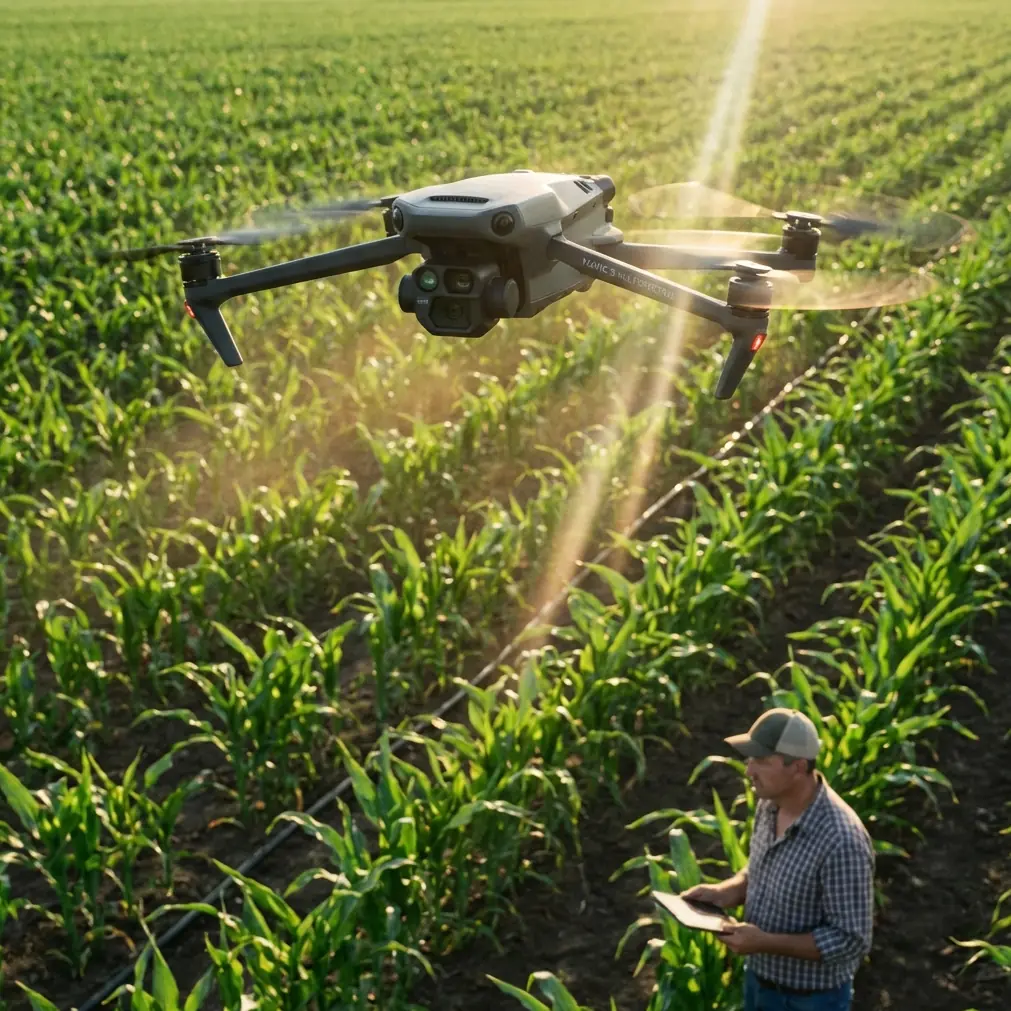
Mavic 3M: Mountain Field Monitoring Made Precise
META: Discover how the Mavic 3M transforms mountain field monitoring with multispectral imaging and centimeter precision. Expert guide for agricultural professionals.
TL;DR
- Multispectral imaging with four discrete spectral bands plus RGB captures crop health data impossible to see with standard cameras
- RTK positioning delivers centimeter precision essential for accurate repeat monitoring on uneven mountain terrain
- 45-minute flight time covers extensive hillside parcels in single missions, reducing operational complexity
- Strategic antenna positioning can extend reliable signal range by 30-40% in challenging topography
Why Mountain Agriculture Demands Specialized Monitoring
Mountain field monitoring presents unique challenges that flatland farmers never encounter. Steep gradients, variable microclimates, and signal-blocking terrain features make conventional drone operations frustrating at best—and dangerous at worst.
The DJI Mavic 3M addresses these challenges directly. Built around a four-band multispectral sensor paired with a 20MP RGB camera, this platform captures the precise spectral data needed to assess crop vigor across elevation changes.
For agricultural consultants working mountain terrain, understanding this drone's capabilities—and limitations—separates successful monitoring programs from expensive failures.
Understanding the Mavic 3M Sensor Array
Multispectral Band Configuration
The Mavic 3M integrates five imaging sensors working simultaneously:
- Green band (560nm ± 16nm): Chlorophyll reflection analysis
- Red band (650nm ± 16nm): Vegetation stress detection
- Red Edge band (730nm ± 16nm): Early stress identification before visible symptoms
- Near-Infrared band (860nm ± 26nm): Biomass and water content assessment
- RGB camera (20MP): Visual reference and general inspection
Each multispectral sensor captures at 5MP resolution, sufficient for generating actionable NDVI, NDRE, and custom vegetation indices across typical agricultural parcels.
Expert Insight: The Red Edge band proves particularly valuable in mountain environments. Elevation-induced stress often manifests in Red Edge reflectance changes 7-10 days before visible symptoms appear in standard RGB imagery.
Sunlight Sensor Calibration
Mounted on the aircraft's upper surface, the integrated sunlight sensor continuously measures ambient light conditions. This automatic calibration compensates for the rapidly changing light conditions common in mountain valleys—where a passing cloud can alter illumination by 40% within seconds.
Without this compensation, multispectral data collected at different times becomes incomparable, undermining the entire purpose of temporal monitoring.
RTK Positioning: The Foundation of Repeat Accuracy
Why Centimeter Precision Matters
Standard GPS positioning delivers accuracy within 1.5-3 meters under ideal conditions. For single-flight mapping, this suffices. For monitoring programs requiring comparison across multiple flights, it creates chaos.
Consider a mountain vineyard with 0.5-meter row spacing. Standard GPS uncertainty means your drone might capture row three on Monday and row five on Thursday—while believing it photographed the same location.
The Mavic 3M's RTK module achieves 1cm + 1ppm horizontal and 1.5cm + 1ppm vertical positioning accuracy. This centimeter precision ensures each monitoring flight captures identical ground positions, enabling true temporal comparison.
RTK Fix Rate Optimization
Maintaining consistent RTK Fix status in mountain terrain requires understanding signal geometry. The drone needs clear sky view to at least five satellites with good geometric distribution.
Factors affecting RTK Fix rate in mountains:
- Horizon obstruction: Ridgelines blocking low-elevation satellites
- Multipath interference: Signals bouncing off rock faces
- Canopy density: Tree cover attenuating signals
- Valley orientation: North-south valleys in northern latitudes receive better coverage
Pro Tip: Schedule flights when satellite geometry favors your specific valley orientation. Use mission planning software to identify optimal windows—often early morning or late afternoon provides better satellite distribution than midday for east-west oriented mountain valleys.
Antenna Positioning for Maximum Range in Mountain Terrain
Signal reliability determines mission success in complex topography. The Mavic 3M controller uses OcuSync 3.0 transmission, but even this robust system struggles when mountains intervene between pilot and aircraft.
Strategic Ground Station Placement
Position yourself to maintain line-of-sight throughout the mission:
- Elevated vantage points: Even 10-15 meters of additional elevation dramatically extends usable range
- Ridge positioning: Operating from ridgelines rather than valley floors keeps the aircraft visible longer
- Avoid metal structures: Farm buildings, irrigation equipment, and vehicles create interference zones
Controller Antenna Orientation
The DJI RC Pro controller antennas transmit in a fan pattern perpendicular to the antenna surface. Pointing antennas directly at the aircraft actually minimizes signal strength.
Optimal technique: Keep antenna faces oriented toward the aircraft's general direction, adjusting as the drone moves across the monitoring area. In mountain operations, this often means tilting the controller backward 15-20 degrees when the aircraft operates above your elevation.
Range Extension Strategies
For extensive mountain parcels exceeding direct transmission range:
- Waypoint missions: Pre-program complete flight paths; the aircraft executes autonomously even if signal drops temporarily
- Multiple launch points: Divide large areas into sectors, repositioning between flights
- Relay positioning: A second operator at an intermediate point can relay visual confirmation (though not control signals)
Technical Specifications Comparison
| Specification | Mavic 3M | Phantom 4 Multispectral | Competitor A |
|---|---|---|---|
| Multispectral Resolution | 5MP × 4 bands | 2MP × 5 bands | 3.2MP × 4 bands |
| RGB Resolution | 20MP | 2MP | 12MP |
| Max Flight Time | 45 minutes | 27 minutes | 32 minutes |
| RTK Accuracy (Horizontal) | 1cm + 1ppm | 1cm + 1ppm | 2cm + 1ppm |
| Wind Resistance | 12 m/s | 10 m/s | 10 m/s |
| Operating Temperature | -10°C to 40°C | 0°C to 40°C | -5°C to 40°C |
| Weather Resistance | IPX6K | None rated | IPX4 |
| Weight | 951g | 1487g | 1250g |
The IPX6K rating deserves attention for mountain operations. Morning fog, unexpected afternoon showers, and heavy dew conditions are routine in mountain agriculture. This water resistance rating means high-pressure water jets won't compromise the aircraft—far exceeding typical agricultural requirements.
Mission Planning for Mountain Terrain
Swath Width Considerations
Multispectral data quality depends on consistent ground sampling distance (GSD). The Mavic 3M's sensors deliver approximately 1.24 cm/pixel at 30-meter altitude for multispectral bands.
For mountain terrain, maintain consistent altitude above ground level (AGL), not above takeoff point. A 50-meter elevation change across a hillside vineyard means your GSD varies by nearly 40% if using fixed altitude above launch.
Enable terrain following using accurate digital elevation models. The Mavic 3M supports terrain following with 30-meter minimum AGL when using DJI's mission planning software.
Overlap Requirements
Standard agricultural mapping uses 75% frontal and 65% lateral overlap. Mountain terrain demands more:
- 80% frontal overlap: Compensates for altitude variations between flight lines
- 75% lateral overlap: Ensures consistent coverage despite terrain-induced attitude changes
- Reduced flight speed: 5-7 m/s rather than the 10-12 m/s typical for flat terrain
These conservative parameters increase flight time per hectare but dramatically improve data quality and processing success rates.
Common Mistakes to Avoid
Ignoring thermal conditions: Mountain valleys experience strong thermal activity, especially on sunny afternoons. Updrafts and downdrafts exceeding 5 m/s compromise multispectral data quality and stress the aircraft's stabilization systems. Fly early morning or during overcast conditions.
Skipping calibration panels: The sunlight sensor handles ambient light changes, but ground-based calibration panels remain essential for absolute reflectance values. Place panels on level ground at your launch point and capture calibration images before and after each mission.
Underestimating battery consumption: Cold mountain temperatures and aggressive altitude changes consume batteries faster than specifications suggest. Plan for 30-35 minutes of actual flight time rather than the rated 45 minutes when operating below 10°C or in demanding terrain.
Neglecting nozzle calibration verification: If using Mavic 3M data to guide subsequent spray applications, verify your sprayer's nozzle calibration matches the prescription map resolution. Spray drift in mountain conditions—where wind patterns shift rapidly—compounds any calibration errors.
Single-flight decision making: Multispectral data reveals its true value through temporal comparison. A single flight shows current conditions; a monitoring series reveals trends. Establish consistent flight schedules—typically 7-14 day intervals during active growing seasons.
Frequently Asked Questions
How does the Mavic 3M handle the reduced air density at mountain elevations?
The Mavic 3M maintains stable flight characteristics up to 6000 meters above sea level. However, reduced air density decreases lift efficiency, increasing power consumption by approximately 3-5% per 1000 meters of elevation. At 3000 meters, expect roughly 10-15% reduction in effective flight time compared to sea-level operations.
Can I process Mavic 3M multispectral data with standard photogrammetry software?
The Mavic 3M outputs standard TIFF files compatible with most agricultural analysis platforms including Pix4Dfields, DroneDeploy, and Agisoft Metashape. The drone embeds necessary metadata for radiometric calibration, though dedicated agricultural software extracts maximum value from the multispectral bands.
What RTK base station options work with the Mavic 3M for mountain operations?
The Mavic 3M supports both DJI D-RTK 2 Mobile Station and NTRIP network connections. For remote mountain locations without cellular coverage for NTRIP, the D-RTK 2 provides independent centimeter precision. Position the base station on stable ground with maximum sky visibility—ridgelines often provide better satellite geometry than valley floors.
Maximizing Your Mountain Monitoring Investment
The Mavic 3M represents a significant capability upgrade for agricultural professionals working challenging terrain. Its combination of multispectral imaging, extended flight time, and robust RTK positioning addresses the specific demands mountain agriculture presents.
Success requires understanding both the technology's capabilities and the environmental factors unique to your operating area. Invest time in learning your local satellite geometry, typical weather patterns, and optimal flight windows before committing to production monitoring schedules.
Ready for your own Mavic 3M? Contact our team for expert consultation.