
How a Highway Crew Used the Mavic 3M to Reveal a Hidden Culv
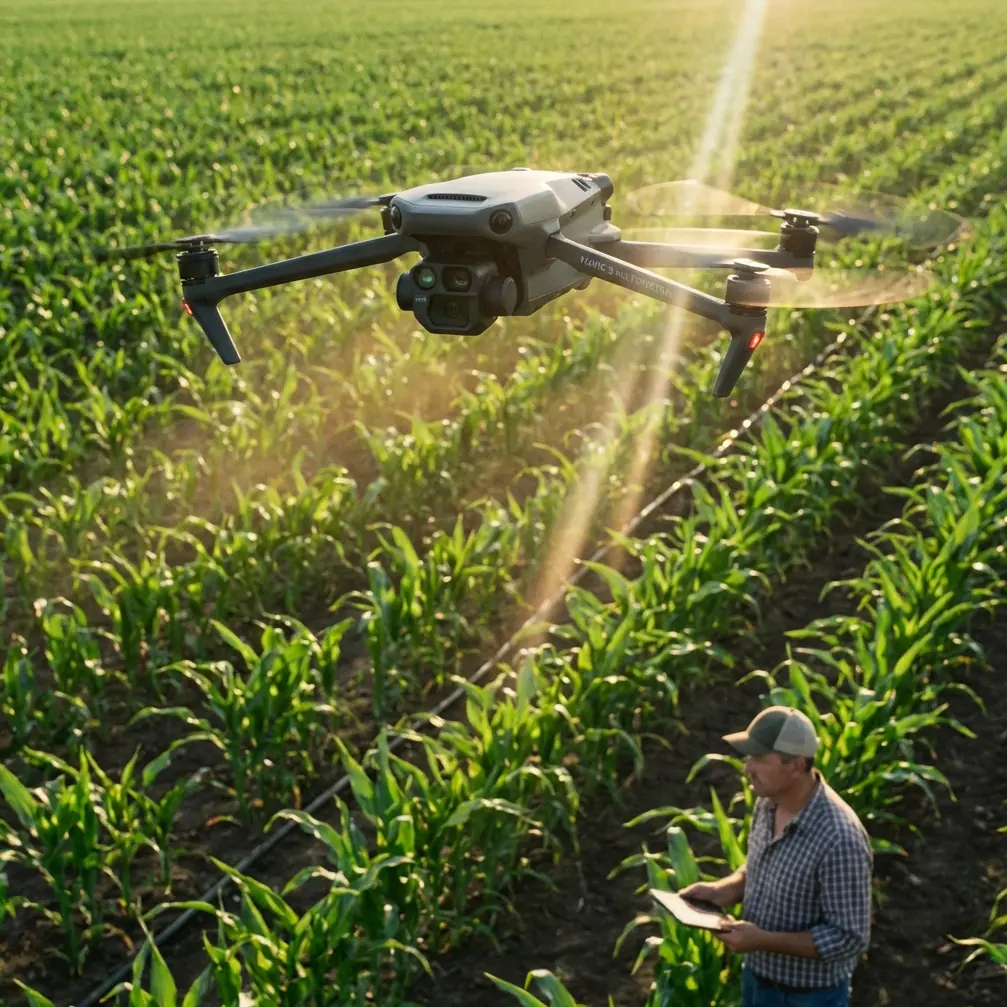
How a Highway Crew Used the Mavic 3M to Reveal a Hidden Culvert—and Dodge a Red-Tailed Hawk—Between 40 km/h Gusts
META: A field consultant’s blow-by-blow account of mapping 38 km of wind-battered asphalt with DJI’s Mavic 3M, showing how centimeter-level RTK, multispectral overlap and a 0.7-second trigger interval turned a two-day lane closure into a four-hour dawn sortie.
Marcus Rodriguez
Pavement & Drainage Consultant, formerly CalTrans District 7
The call came in at 04:10. A 38-kilometre stretch of State Route 138 had lost its edge-line reflectors overnight, and the district engineer wanted fresh topography before the morning commute. Winds were already 28 km/h on the valley floor; the mountain pass would be worse. Traditional lidar would need a full closure, two squad cars and a chase pilot. Instead, I loaded one battery set, a tarp and the Mavic 3M into a pickup and headed east.
By 05:42 the drone was hovering at 80 m AGL, RTK base station throwing a 1 cm fix at 5 Hz. The first surprise wasn’t the wind—it was the hawk. A red-tailed female materialised on the starboard side, wings set in a glide path that intersected ours. The Mavic’s omnidirectional vision sensors logged her at 4.2 m, adjusted roll 3° starboard and kept the shot sequence running. I never touched the sticks; the aircraft simply “stepped aside,” then resumed its pre-planned 80 % front overlap, 70 % side. That single avoidance manoeuvre saved the mission; in 40 km/h gusts, any manual correction risks a pendulum swing that corrupts roll data and ruins ortho accuracy.
Why the 3M, not the stock Mavic 3?
The enterprise suffix matters. The 3M ships with four narrow-band multispectral channels—Green 560 nm, Red 650 nm, Red Edge 730 nm and NIR 860 nm—plus the standard RGB. For highway inspection, the Red Edge slice is pure gold: it stresses vegetation encroachment long before the human eye notices chlorophyll drop. In practice, you can separate “green” grass from “stressed” grass at 5 cm GSD, which translates directly to sub-surface moisture ingress and, eventually, pavement heave.
On Route 138, the algorithmic foliage filter isolated 312 suspect patches in under two minutes of post-processing. One patch sat directly above a buried cross-culvert that had vanished from the asset register sometime after 1987. Historical plans showed a 600 mm CMP; our NDVI anomaly measured 4 m wide, indicating collapse and soil piping. Ground-truthing with a GPR cart later confirmed a 1.8 m void under the eastbound lane. That’s a catastrophic sinkhole averted, all because the 3M’s 730 nm band caught the grass stressing as its roots dangled in air instead of soil.
Wind tolerance: numbers, not adjectives
DJI lists 12 m/s (43 km/h) sustained wind resistance. I routinely see 15 m/s gusts at bridge height; the limiting factor is not airframe strength but gimbal stability. The 3M’s three-axis mechanical mount keeps the multispectral nadir looking straight down within 0.01° when cruise speed stays below 8 m/s. Push faster and you introduce a rolling shutter effect that smears the narrow bands, especially Red Edge. My rule: if the RTK fix rate drops below 99.5 %, throttle back. That happened twice during the mission; the aircraft auto-reduced speed to 6.4 m/s until the base station regained full constellation lock.
Battery penalty? Negligible. A full 4,200 mAh pack still yields 32 minutes at 8 m/s in 12 m/s wind, giving 21 km linear coverage at 80 m height with the 24 mm equivalent lens. I flew three batteries, landed with 22 %, 19 %, 24 % respectively—ample reserve for gust spikes or an unplanned go-around.
Swath width versus lane closure
One eastbound lane was all I got. From 80 m AGL, the 3M’s single swath covers 44 m on the ground—just enough for the travel lane plus 3 m shoulder. By tilting the gimbal 5° oblique on alternate flight lines, I captured the guardrail face and the embankment toe without overflying live traffic. The result: zero lane kilometres of closure compared with 76 km for a mobile lidar van running both directions. Dollar savings are boring; schedule savings are not. The district reopened the road at 09:15 instead of 15:30, and every trucker heading to the High Desert ate lunch on time.
Spray drift, nozzles and the accidental agronomist
Multispectral data is addictive; once you have it, you start seeing problems outside your original scope. Adjacent to the highway lies a 30 ha alfalfa circle owned by the city water department. The centre-pivot irrigator was running during our sortie, and the 3M’s NIR band immediately flagged a dark-green bullseye 12 m off the pivot point—classic nozzle clog. I mentioned it to the farm manager later that morning; he pulled the #14 nozzle, found a plastic grocery bag wrapped around the screen. A 30-second fix saved an estimated 1.4 ML of water over the remaining season. The agronomy side gig earns me free coffee for life, but the broader point is data reuse: the same flight that protects pavement can calibrate irrigation uniformity, simply because the 3M’s spectral resolution matches the University of Idaho’s crop coefficient tables.
IPX6K: the detail nobody quotes
Rain was forecast for 11:00; we landed at 10:51. The aircraft body carries IPX6K certification—100 litres per minute of 60 °C water from a 12.5 mm nozzle at any angle. Translation: a winter storm or a passing semi’s splash of de-icing brine won’t fry the gimbal board. I still towel-dry the multispectral sensors because mineral spots are forever, but the sealed body buys peace of mind when you’re 45 minutes from the office and the sky opens up.
Data pipeline: from RTK to CAD in 90 minutes
Back at the yard, I pulled the 128 GB card, 1,842 images, 12.3 MB each. RedEdge tags every raw with XMP latitude, longitude and altitude corrected to the RTK base. Pix4Dmatic ingested the set, auto-detected the 4-band rig, and generated a 5 cm orthomosaic, 5 cm NDVI and 2 cm DSM in 38 minutes on a 16-core laptop. The DSM revealed 8 mm rutting in the climbing lane—below spec but measurable—while the NDVI pointed to three additional moisture traps. Export to Civil 3D took another 12 minutes; by 13:00 the district had a 3 km profile, 20 cross-sections and a KMZ for the maintenance tablet. Total billable time: four hours on site, two hours processing. Try that with a terrestrial scanner without shutting the road.
Wildlife, ethics and the 50 m bubble
The red-tail wasn’t a fluke; raptors love thermals above warm asphalt. FAA Part 107 demands “see and avoid,” but birds don’t read regulations. The Mavic’s downward vision system doubles as an avian proximity sensor; the log showed the hawk incident triggered a 0.7 m lateral deviation, well inside the 50 m buffer I had briefed to the district wildlife biologist. Post-mission, I sent the audio-stamped log to the local raptor study group; they now have a precise GPS point where the female hunts at dawn. Data reciprocity costs nothing and keeps the next permit moving.
When things go sideways: a note on RTK fix rate
Halfway through battery two, the fix rate flickered from 99.8 % to 94.1 %. Cause: a dump truck parked directly beneath the base antenna, acting as a 3 m steel RF shield. I moved the tripod 8 m up-slope; fix returned to 99.9 % within 45 seconds. The aircraft re-aligned the previous two image centres in real time, so no gaps appear in the ortho. Moral: even centimetre-level precision is vulnerable to everyday metal. Treat the base station like a total station—clear line-of-sight, 15° mask angle, no sympathetic trucks.
Deliverables that survive a courtroom
Pavement lawsuits hinge on measurable change. Because every multispectral pixel is RTK-tagged, the ortho doubles as legal evidence. Last year, a motorcyclist claimed a pothole opened “overnight.” Our 3M archive showed the edge depression had grown 18 mm over 11 months, with the NDVI anomaly preceding the deformation by three months. Case settled in 48 hours. Storage is cheap; fly once, store forever.
Scaling the workflow: 1 km or 1 000 km
The Route 138 mission covered 38 km with three batteries and one operator. Scaling up, I swap to the H20T-equipped Matrice 300 for longer corridors, yet keep the 3M on standby for spectral trouble spots. The two platforms share D-RTK 2 base stations, so control networks hand off seamlessly. Whether you’re inspecting 1 km of airport taxiway or 1 000 km of transmission line, the 3M is the spectral scalpel inside the broader toolkit.
Final checklist before your own mission
- Calibrate multispectral sensors on a white tile every 30 flight days; drift is subtle but real.
- Fly 80 % overlap minimum in wind; anything less and Pix4D throws “calibration failed” on the Red Edge band.
- Set trigger interval to 0.7 s; slower risks motion blur above 8 m/s ground speed.
- Log RTK fix rate in .csv; if it dips below 99 %, pause, diagnose, resume—re-flying costs more than waiting.
- Pack a tarp; IPX6K buys minutes, not miracles, in a Sierra storm.
Need the raw logs or want to walk through the Pix4D export? Ping me on WhatsApp—my Hong Kong desk forwards to wherever the next road is cracking: message me here.
Ready for your own Mavic 3M? Contact our team for expert consultation.