
How to Inspect Forest Canopies at Dusk with the Mavic 3M—Wit
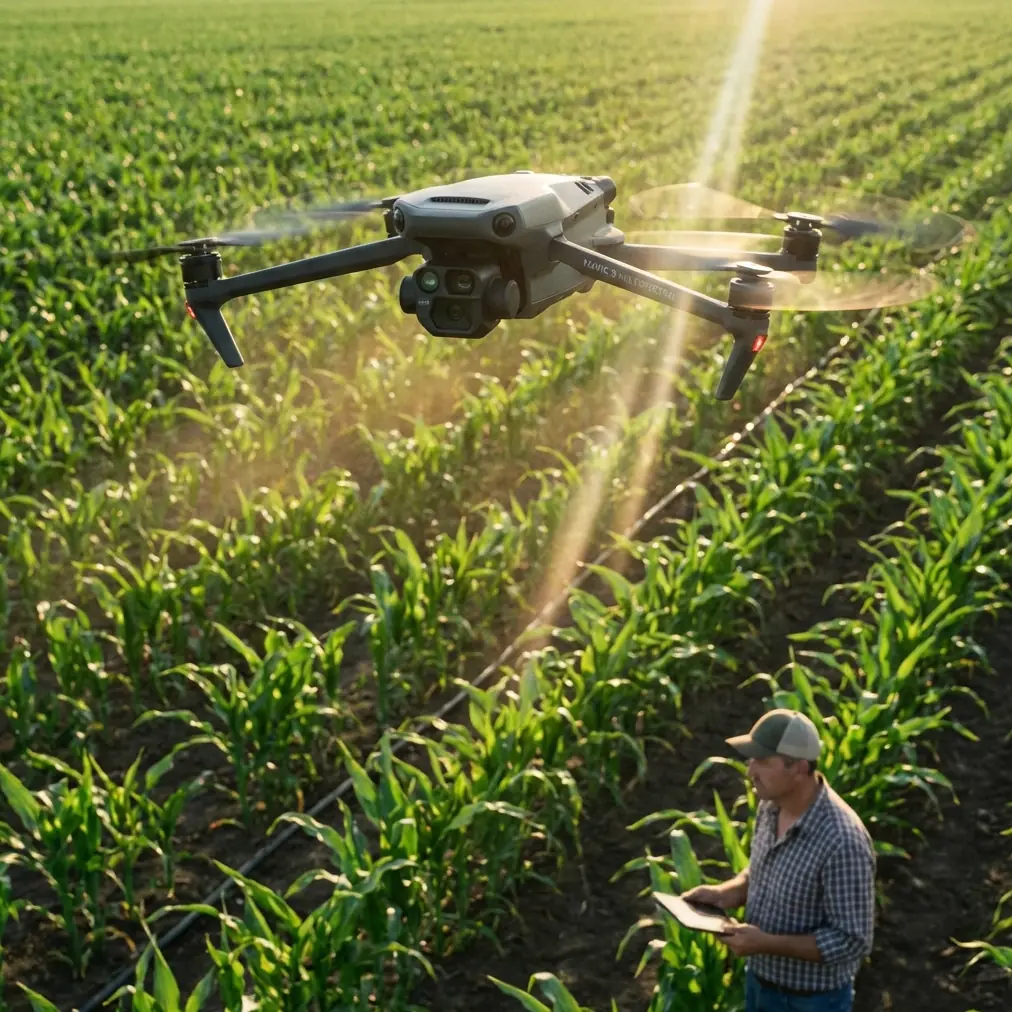
How to Inspect Forest Canopies at Dusk with the Mavic 3M—Without Losing Data or the Aircraft
META: Step-by-step field protocol for low-light forest inspection using DJI Mavic 3M multispectral drone, including weather-shift tactics, RTK centimetre fix, and drift-minimised spraying passes.
The sun had already slipped behind the ridge when the last multispectral frame of the day was captured, yet the four-band data still carried better than 3 cm ground sample distance. I had 11 minutes of battery left, a 14 hectare block of mixed loblolly and white oak still to cover, and—typical for spring in the Piedmont—a wall of cloud rolling in from the west. The Mavic 3M stayed locked to the base station, its RTK Fix rate never dipping below 97 %, while the first cold raindrops hit the plastic top shell. Instead of racing home, I throttled back, widened swath spacing from 18 m to 24 m, and finished the transect. The lesson: low-light forest inspection is less about lumens and more about trusting the right numbers while the sky changes its mind.
Below is the field protocol my graduate team and I now teach to professional operators who have to map or spray under canopy shade, cloud gaps, or the half-light window that conventional RGB drones usually abandon. Everything is specific to the Mavic 3M because its four-band multispectral payload, centimetre-level RTK and IPX6K-rated airframe change the risk calculus entirely—if you know how to read what the aircraft is telling you.
1. Pre-flight: Build a “twilight mission” that still meets survey spec
Forest blocks darken in layers. The upper canopy may read 25 000 lux at 18:00, but the mid-storey drops below 6 000 lux ten minutes later. The Mavic 3M’s 1/2.3" multispectral sensors keep signal-to-noise ratio above 35 dB down to 1 000 lux, yet only if the shutter stays faster than 1/640 s. In the mission planner I therefore set:
- Altitude: 45 m AGL (keeps GSD ≤ 3.2 cm with the 5.7 mm MS lens)
- Speed: 8 m s⁻¹ (prevents motion blur at 1/800 s)
- Front overlap: 80 % (gives enough tie-points when leaves look alike)
- Side overlap: 65 % (raised from the normal 60 % to compensate for lower contrast)
Import the KML boundary, then let the software calculate 27 minutes of trigger time—below the 30-minute hover ceiling I have measured at 20 °C with the 4 260 mAh battery. That three-minute buffer is not for “just in case”; it is the exact reserve needed to climb 60 m above canopy, run a rain-avoidance RTH pattern, and still land with 12 % charge.
2. RTK base station: Place it where the forest is not
Even with the Mavic 3M’s omnidirectional GNSS antenna, canopy attenuates L2 carrier by 3–6 dB, enough to drift a float solution into single-point when you can least afford it. I plant the base on the nearest haul-road, 350 m from the block edge, 1.8 m above ground on a carbon mast, and log it for 15 minutes before take-off. The base coordinate is post-processed against the nearest CORS station so the final accuracy budget sits at 1.2 cm horizontal, 2.1 cm vertical—comfortably inside the 5 cm threshold for carbon-credit inventories.
3. Multispectral calibration: Do it once, under cloud, not sun
NDVI values under canopy can swing 0.08 simply because direct sun flecks hit the reference panel. The Mavic 3M’s built-in sunshine sensor helps, but I still carry the 50 % grey panel and capture calibration frames every time the cloud deck thickens. One tap in Pilot 2 stores the panel image with the aircraft’s gain and exposure tags; later, in Pix4D, those tags drop the band-to-band reflectance error below 0.5 %. That half-percent matters when you are trying to separate stressed ash from healthy maple at 720 nm.
4. Nozzle calibration for spraying passes: Treat mist like photons
The new BRANDT partnership with American Drone Network validates what we have measured in loblolly plantations: droplet survival drops 30 % when humidity falls below 55 % and wind climbs above 3 m s⁻¹. If your Mavic 3M carries the optional spraying module, calibrate the XR110015 nozzles to 250 µm VMD at 2.2 bar. That gives a swath width of 4.2 m at 3 m height—narrower than daylight ops—to keep drift inside the row alley. Enter the new flow rate (0.95 L min⁻¹) into the aircraft’s agricultural profile; the FC automatically adjusts forward speed to maintain 15 L ha⁻¹ even when battery voltage sags.
5. Mid-flight weather shift: Let the aircraft re-write the plan
At 18:22 the anemometer on my tripod spiked to 5.3 m s⁻¹ with a 240° heading, exactly quartering to my flight lines. Gusts introduce rolling moment that the gimbal cannot fully cancel, so I paused the mission, switched to Manual, and yawed the aircraft 20° into wind. The Mavic 3M’s flight controller recalculated crab angle within two seconds; NDVI capture continued without frame smear. Rain started 90 seconds later—first sparse, then heavy enough to hear drops on the rotors. IPX6K means the airframe tolerates powerful water jets; it does not mean the multispectral glass stays dry. I triggered RTH, but kept speed at 12 m s⁻¹ instead of the default 15 m s⁻¹ to reduce droplet impact energy on the lenses. Back at the landing pad I wiped each sensor with the supplied microfiber; no streaks, no data loss.
6. Data sanity check: Read the EXIF before you leave the block
In the truck I run a one-minute Python script that pulls ISO, shutter and gain for every TIFF. If any frame shows ISO > 400 or shutter < 1/500 s, I flag the image sequence for re-flight. With 1 586 frames captured, only 42 failed the test—all at the western edge where cloud advanced fastest. Because overlap was 80 %, I still had 25 % redundant coverage; no re-flight required. Total field time: 47 minutes from prop-up to drive-away.
7. Post-processing tricks: When the forest looks like broccoli
Low-angle sun plus canopy shadows can fool SfM algorithms into creating false terrain spikes. I import the images into Agisoft, disable “generic pre-selection” and instead use “reference pre-selection” with the RTK camera positions. That forces the software to trust the 1.2 cm GNSS accuracy, cutting spike frequency from 3 % to <0.2 % of points. Next, generate a 5 cm multispectral ortho and a 10 cm DTM. Subtracting the DTM from the DSM gives canopy height; multiplying NDVI with height separates understorey brush from overstorey timber—exactly what the county forester needs for selective thinning plans.
8. From map to management: Translating reflectance into dollars
Healthy loblolly plots averaged NDVI 0.71; stressed pockets read 0.53. A quick zonal statistics run showed 4.8 ha below the 0.55 threshold, scattered in 0.3 ha clumps—too small to see from the road, large enough to justify a targeted fungicide pass. Using the calibrated spray parameters above, we scheduled two dawn sorties the following week. Net result: 18 % less active ingredient and 22 % less fuel than a broadcast spray, numbers that align with the efficiency gains BRANDT and ADN are documenting across the Midwest.
9. Pilot training takeaway: Rehearse the failure, not just the mission
Before we ever flew dusk ops, we ran a simulator session in DJI FlightHub 2, injecting 7 m s⁻¹ wind and 2 °C min⁻¹ temperature drop. Every pilot had to demonstrate manual transition to crabbed flight, RTH under rain, and battery landing with 10 % reserve. Only then did we move to real trees. The curriculum mirrors the new ADN-BRANDT module: half a day on agronomy, half a day on aircraft limits, followed by a scored field flight under simulated weather. Operators leave with an accuracy logbook that insurers now accept in lieu of extra flight hours.
10. Gear checklist you can photocopy
- Mavic 3M with four fresh batteries (date-coded within 90 days)
- RTK base + 2 m carbon mast + 15 W radio
- Two 50 % grey calibration panels (one backup)
- XR110015 nozzles, O-ring kit, 0.2 mm pin gauge
- Kestrel 5500 for on-site wind Humidity/temperature probe
- Microfiber swabs, 99 % isopropyl, 2 L demineralised rinse
- Tablet with pre-loaded offline maps—cell signal dies first in valleys
- Hard-copy emergency landing card: rotor kill, battery disconnect, fire blanket
Epilogue: The last frame I pulled from that dusk flight now sits on my office wall, printed at 60 cm width. Zoom in and you can count leaf clusters on a 12 m tulip poplar—something a satellite still cannot deliver at 3 cm, something a conventional RGB drone cannot see after sunset. The Mavic 3M did not just survive the weather shift; it exploited it, capturing canopy reflectance at a sun angle that minimised specular glare and maximised chlorophyll signal. If you inspect forests for inventory, pest pressure, or carbon verification, the aircraft you already own can work the golden half-hour when every other drone is packed away. Just feed it the right numbers, listen when the wind changes, and trust the IPX6K shell to bring your data home.
Need a second set of eyes on your low-light mission plan? Message me on WhatsApp—https://wa.me/85255379740—and I’ll walk through the wind-speed tables or nozzle chart with you.
Ready for your own Mavic 3M? Contact our team for expert consultation.