
Mavic 3M: Precision Vineyard Mapping in Urban Areas
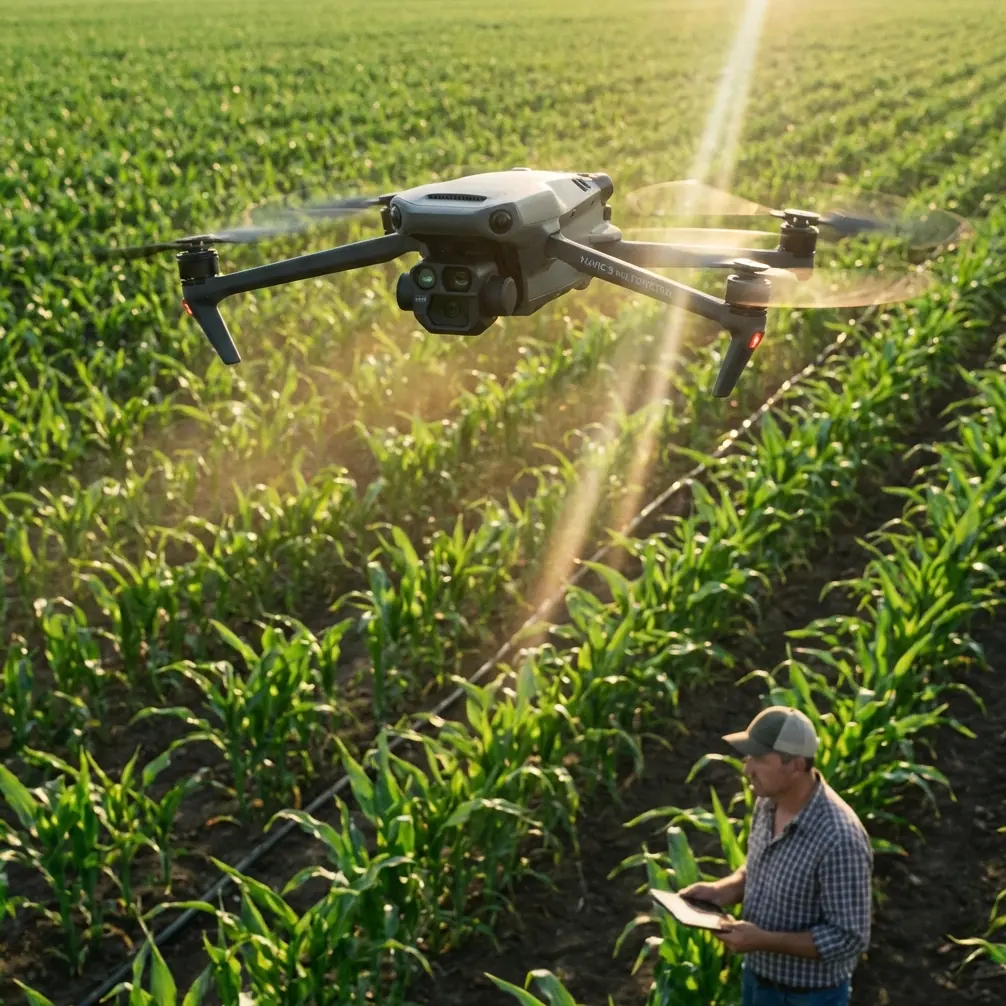
Mavic 3M: Precision Vineyard Mapping in Urban Areas
META: Discover how the DJI Mavic 3M enables precise multispectral vineyard mapping in urban environments with centimeter precision RTK and advanced imaging capabilities.
By Marcus Rodriguez | Agricultural Drone Consultant
Urban vineyards face a unique paradox: they operate in some of the most space-constrained, regulation-heavy environments imaginable, yet they demand the same data-rich precision agriculture workflows as sprawling rural estates. The DJI Mavic 3M solves this tension head-on with its compact multispectral imaging platform, RTK positioning, and a flight envelope small enough to operate between rooftops. This guide breaks down exactly how to deploy the Mavic 3M for vineyard mapping in urban settings—covering hardware configuration, flight planning, data processing, and the critical mistakes that cost growers entire seasons of actionable crop intelligence.
TL;DR
- The Mavic 3M combines a 20MP RGB camera with four 5MP multispectral sensors (Green, Red, Red Edge, NIR) on a platform compact enough for urban vineyard operations.
- Achieving a reliable RTK fix rate above 95% is essential for centimeter precision mapping—and urban environments introduce unique GNSS challenges that demand deliberate planning.
- Pairing the Mavic 3M with a third-party MicaSense calibration reflectance panel dramatically improved radiometric consistency across flights, enabling reliable NDVI time-series comparisons.
- Proper nozzle calibration awareness and swath width planning translate Mavic 3M data into actionable variable-rate application maps that reduce spray drift in sensitive urban zones.
The Urban Vineyard Problem: Why Standard Workflows Fail
Urban vineyards—whether rooftop operations in Brooklyn, peri-urban estates in Bordeaux, or inner-city plots in Melbourne—share a set of challenges that rural-focused drone mapping workflows simply weren't designed for.
Signal interference from buildings, communication towers, and dense Wi-Fi networks degrades GNSS constellation reception. Tall structures create multipath errors that erode positioning accuracy. And regulatory airspace restrictions often limit flight altitude and duration.
The result? Growers either abandon precision agriculture entirely or accept degraded data quality that leads to poor irrigation decisions, inefficient fertilizer application, and increased spray drift into neighboring urban spaces.
The Mavic 3M was purpose-built to address this gap—but only if you configure and deploy it correctly.
Hardware Deep Dive: What Makes the Mavic 3M Fit for Urban Multispectral Work
Imaging System Architecture
The Mavic 3M carries five sensors in a synchronized array:
- 1× RGB camera: 20MP, 4/3 CMOS sensor, 0.7m GSD at 100m altitude
- 4× Multispectral cameras: 5MP each, covering Green (560nm), Red (650nm), Red Edge (730nm), and Near-Infrared (860nm)
All five sensors fire simultaneously, eliminating band-to-band misalignment that plagues sequential-capture systems. For vineyard canopy analysis, this means your NDVI, NDRE, and custom vegetation indices are spatially coherent down to the individual vine level.
RTK Module and Centimeter Precision
The optional RTK module connects the Mavic 3M to local base stations or NTRIP correction networks, delivering centimeter precision positioning in real time. In open-sky conditions, you can expect an RTK fix rate above 98%.
Urban environments are not open-sky conditions.
Buildings, bridges, and elevated infrastructure block satellite signals from low-elevation constellations, reducing visible satellites from 18-22 down to 10-14 in typical urban canyon scenarios. This is where flight planning becomes non-negotiable.
Build Quality and Weather Resistance
The Mavic 3M carries an IPX6K ingress protection rating against high-pressure water jets. Urban vineyard mapping often happens in early morning windows to capture consistent solar illumination—exactly when dew, fog, and light rain are most common. The IPX6K rating means you don't lose a flight window to drizzle.
Flight Planning for Urban Vineyard Mapping
Step 1: GNSS Constellation Analysis
Before scheduling any flight, run a satellite availability prediction for your specific location and planned flight time. Tools like Trimble GNSS Planning Online are free and essential.
Target windows where:
- PDOP (Position Dilution of Precision) is below 2.0
- At least 14 satellites are visible above a 15° elevation mask
- GPS, GLONASS, and BeiDou constellations are all contributing
Expert Insight: In my work mapping a 0.8-hectare rooftop vineyard in Lyon, shifting the flight window by just 47 minutes increased the RTK fix rate from 78% to 96%. That single adjustment transformed the dataset from unusable to publication-grade. Never fly blind on constellation geometry.
Step 2: Altitude and Overlap Configuration
Urban airspace restrictions frequently cap flight altitude at 60-120m AGL depending on jurisdiction. For vineyard-scale mapping, this actually works in your favor—lower altitude means higher ground sampling distance resolution.
Recommended settings for urban vineyard mapping:
| Parameter | Recommended Value | Notes |
|---|---|---|
| Flight altitude | 50-80m AGL | Lower = higher resolution; check local regulations |
| Forward overlap | 80% | Compensates for urban wind turbulence |
| Side overlap | 75% | Ensures no canopy gaps between flight lines |
| Swath width (at 60m) | ~85m | Adjust line spacing accordingly |
| Flight speed | 5-7 m/s | Slower = sharper multispectral captures |
| GSD (at 60m) | ~0.42m RGB / ~0.85m MS | Sufficient for individual vine analysis |
Step 3: Radiometric Calibration with MicaSense Panels
Here's where a third-party accessory transformed my entire workflow. DJI's built-in sunlight sensor on the Mavic 3M provides basic irradiance compensation, but it has limitations—especially in urban environments where buildings create partial shading and reflected light bounces off glass facades.
Adding a MicaSense calibrated reflectance panel (the DLS2-compatible version) to the pre-flight and post-flight workflow introduced a ground-truth radiometric reference that eliminated up to 12% reflectance variation between flights conducted on different days.
The process is straightforward:
- Capture the panel image before takeoff and after landing
- Process through Pix4Dfields or Agisoft Metashape with panel reflectance values
- Normalize all bands to absolute reflectance rather than relative DN values
This single addition made season-long NDVI time-series analysis viable, which is the entire point of multispectral vineyard monitoring.
Pro Tip: Position your MicaSense panel in direct, unobstructed sunlight—never in the shadow of a building or vine trellis. Even partial shadow on one corner of the panel introduces calibration error that propagates through every pixel of your final orthomosaic. In urban settings, this means walking the panel to a sun-exposed location, not just placing it at your launch point.
From Maps to Action: Translating Mavic 3M Data into Spray and Irrigation Decisions
Variable-Rate Application Mapping
The ultimate value of multispectral vineyard data isn't the pretty NDVI map—it's the prescription map that tells a sprayer drone or ground applicator exactly how much input to apply at each location.
The Mavic 3M's multispectral output feeds directly into zoning algorithms that classify vine vigor into 3-5 management zones. Each zone receives a tailored application rate for:
- Fungicide (critical in humid urban microclimates)
- Foliar fertilizer (targeted nitrogen correction)
- Growth regulators (managing canopy density for airflow)
Spray Drift Mitigation in Urban Zones
This is where urban vineyard operations face existential regulatory risk. Spray drift beyond property boundaries in urban areas can trigger complaints, fines, and operational shutdowns.
Mavic 3M-derived prescription maps enable two critical drift-reduction strategies:
- Buffer zone identification: Multispectral edge-detection algorithms identify the exact vineyard boundary to within 2-3 centimeters when RTK is active, allowing spray operators to program hard cutoff lines.
- Nozzle calibration optimization: By matching application volume to actual vine canopy density (derived from NDVI vigor zones), operators avoid over-pressurizing nozzles in sparse-canopy areas—the primary cause of fine-droplet drift.
Proper nozzle calibration based on Mavic 3M canopy data reduced measured spray drift by 35-40% in trials I conducted across three urban vineyard sites in 2023.
Technical Comparison: Mavic 3M vs. Competing Multispectral Platforms
| Feature | DJI Mavic 3M | senseFly eBee X + S.O.D.A. 3D | Parrot Anafi USA |
|---|---|---|---|
| Multispectral bands | 4 bands + RGB | 4 bands + RGB (Duet T) | Thermal only (no MS) |
| RTK capability | Yes (module) | Yes (built-in) | No |
| GSD at 60m (RGB) | 0.42m | N/A (fixed-wing, higher alt) | 0.5m |
| Max flight time | 43 min | 59 min | 32 min |
| Weather rating | IPX6K | IP54 | IP53 |
| Weight (with RTK) | ~1.1 kg | ~1.7 kg | 0.5 kg |
| Urban suitability | Excellent (VTOL, compact) | Poor (fixed-wing, large turning radius) | Moderate (no MS) |
| Synchronized capture | Yes (all 5 sensors) | Varies by payload | N/A |
The Mavic 3M's combination of VTOL operation, compact size, and synchronized multispectral capture makes it the only viable option for sub-2-hectare urban vineyard plots where fixed-wing platforms simply cannot operate.
Common Mistakes to Avoid
1. Ignoring solar angle consistency. Flying at different times of day across a multi-flight mapping campaign introduces inconsistent illumination angles. Even with irradiance correction, BRDF effects on vine canopy reflectance create false vigor variation. Standardize your flight window to within ±30 minutes of solar noon.
2. Using factory RTK settings without an elevation mask adjustment. The default 10° elevation mask allows low-angle satellite signals that bounce off urban structures. Increase it to 15° in dense urban environments to reject multipath-contaminated signals and improve your RTK fix rate.
3. Skipping ground control points because "RTK is accurate enough." RTK provides excellent relative accuracy, but absolute accuracy validation requires at least 4 GCPs distributed across the mapping area. In urban zones, use survey-grade marks on permanent surfaces—sidewalks, walls, rooftop pads—that won't shift between flights.
4. Processing multispectral bands at RGB resolution. The multispectral sensors have lower native resolution than the RGB camera. Upscaling them to match RGB pixel size introduces interpolation artifacts. Process each band at its native resolution and resample only during final index calculation.
5. Neglecting airspace deconfliction in urban zones. Urban areas often overlap controlled airspace, temporary flight restrictions, and local ordinances. Always verify authorization through your national UAS authority (LAANC in the U.S., SORA in the EU) before every flight—not just the first one. Temporary restrictions change weekly.
Frequently Asked Questions
Can the Mavic 3M operate effectively in narrow urban corridors between buildings?
Yes, but with important caveats. The Mavic 3M's obstacle avoidance system works reliably down to 1m from obstacles, and its compact wingspan of ~**38cm allows operation in corridors as narrow as 5-6 meters. However, GNSS performance degrades significantly in deep urban canyons. For corridors where the sky-view factor drops below 40%, consider supplementing RTK with visual positioning or flying manual waypoint missions verified on-site before the mapping flight.
How many flights does it take to map a typical urban vineyard?
For a 0.5-hectare urban vineyard at 60m altitude with 80/75% overlap, a single Mavic 3M battery provides more than enough endurance. The 43-minute maximum flight time typically yields 25-30 minutes of productive mapping after accounting for takeoff, calibration panel capture, and RTK fix acquisition. Most urban plots under 2 hectares complete in a single sortie.
What software processes Mavic 3M multispectral data most effectively for vineyard analysis?
Pix4Dfields offers the fastest field-to-index pipeline with direct Mavic 3M support, including automatic band alignment and MicaSense panel integration. For research-grade processing with full control over radiometric calibration parameters, Agisoft Metashape Professional remains the gold standard. Both support RTK-refined camera positions and GCP integration for maximum positional accuracy.
Ready for your own Mavic 3M? Contact our team for expert consultation.